Cabinet
24/7 Support
24/7 Support
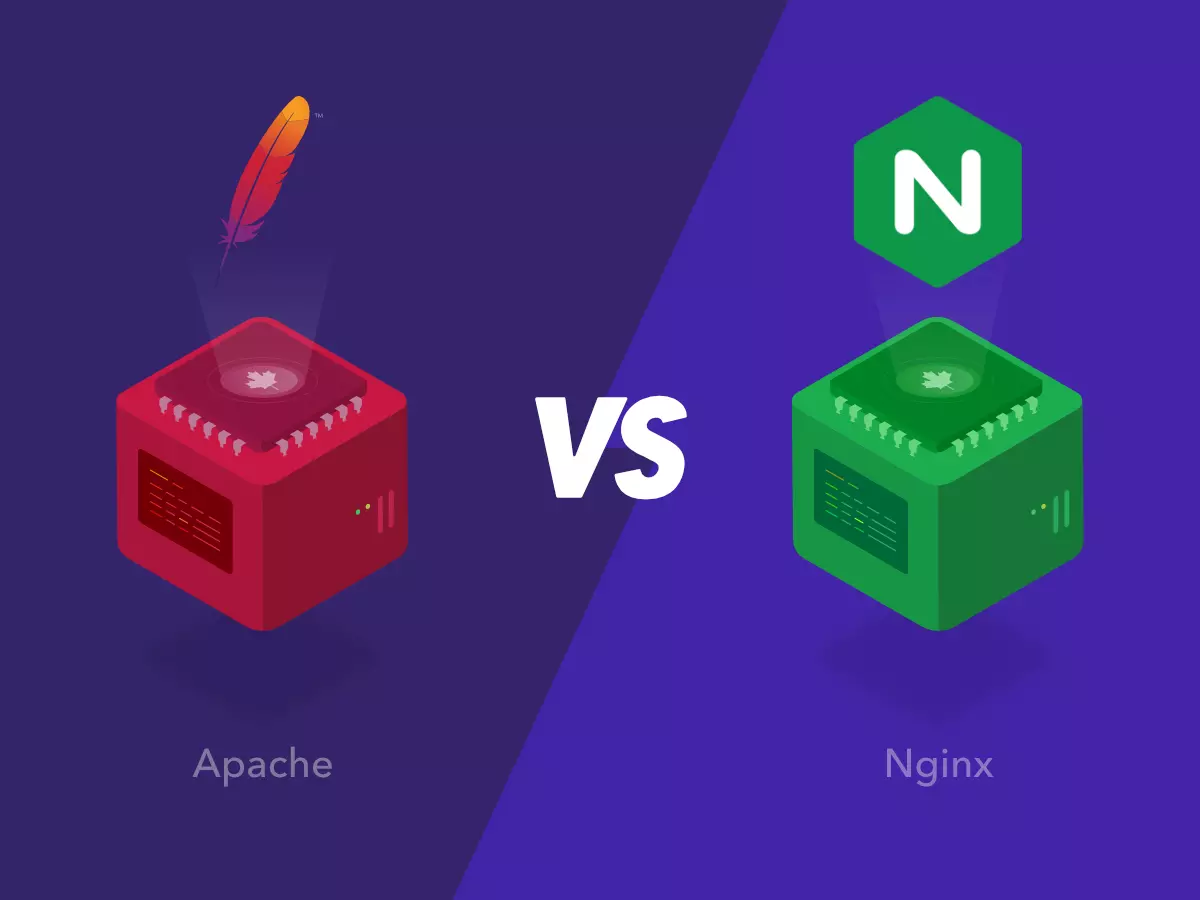
Choosing a web server is one of the key stages when launching or scaling a website. It affects content delivery speed, site behavior under load, configuration flexibility, and ease of further administration. Apache and Nginx are the two most well-known web servers, but they are built on different approaches, so the choice between them depends not on popularity, but on the specific project requirements. At the same time, when choosing a server, it is important to evaluate the basic infrastructure — for example, how to choose hosting for a website and why an SSL certificate is essential for stable operation.
A web server is software that receives HTTP/HTTPS requests from a browser or another client and returns a page, file, image, or other content in response. Static content can be served directly by the server, while dynamic content usually requires additional processing through modules, CGI, FastCGI, or separate application processes depending on the configuration.

Apache HTTP Server is one of the most widely used web servers, valued for its modularity and flexibility. In modern versions, Apache is not limited to a single “process-based” model: it supports several MPMs, including prefork, worker, and event, and its behavior under load depends on the selected processing module.
One of the main reasons Apache is still commonly used for CMS projects is support for .htaccess. These files allow configuration at the directory level without modifying the main server configuration file. This is especially common for WordPress, particularly for handling “pretty” URLs and rewrite rules. If a website runs in a typical shared hosting environment, it is also important to understand what shared hosting is and how it affects configuration capabilities. For CMS-based projects, it is also useful to have a guide on how to install WordPress on hosting.
Advantages of Apache:
Limitations of Apache:
Nginx is designed around an event-driven model. It operates with a master process and worker processes, distributing requests efficiently without following a “one process per request” model. That is why Nginx is often chosen for handling a large number of simultaneous connections, serving static content, acting as a reverse proxy, caching, and load balancing. If content delivery speed is critical, it is also useful to understand how a CDN helps reduce server load.
Unlike Apache, Nginx does not support .htaccess. All rules are defined through centralized configuration, making management more predictable, although sometimes less convenient for beginners. Dynamic content in typical PHP setups is usually handled via FastCGI or PHP-FPM.
Advantages of Nginx:
Limitations of Nginx:
To determine which web server is best for your website, it is important to evaluate their key characteristics. Below is a comparison of Apache and Nginx across major parameters:
| Parameter | Apache | Nginx |
| Architecture | Process-based, creates separate processes or threads per request | Event-driven, asynchronous handling of multiple requests |
| Performance | Good, but may decrease under heavy load | High even with thousands of simultaneous connections |
| Resources | Uses more CPU and RAM | Efficient use of memory and CPU |
| Dynamic content | Built-in support for PHP, Python, etc. | Requires external processes (PHP-FPM, FastCGI) |
| Configuration | Easily configurable via .htaccess | Centralized configuration, no .htaccess support |
| CMS support | WordPress, Joomla, Drupal — seamless | Works, but requires additional setup |
| Scalability | Requires additional solutions for high traffic | Easily scalable, well-suited for CDN and load balancing |
Conclusion:
Apache is more suitable for dynamic websites and complex CMS platforms where configuration flexibility is important. Nginx is optimal for high-load resources, static websites, and projects where performance and scalability are critical.
Apache is worth considering if:
The advantage of Apache in such cases lies in easy integration of dynamic scripts and the ability to configure locally without access to main server files. It allows quick changes, testing of new modules, and support for legacy CMS without compromising stability.
Nginx is the right choice if:
Thanks to its event-driven architecture, Nginx efficiently handles thousands of requests simultaneously, ensures stability under high load, and scales easily, making it ideal for modern web projects and high-traffic platforms.

For high-load projects or complex logic, a combination of Nginx + Apache is often used. In this architecture, Nginx acts as a frontend server: it handles incoming requests, serves static content, and manages caching and load balancing. Dynamic requests are then passed to Apache, which processes PHP, Python, or other scripts using the flexibility of .htaccess and modules.
Advantages of this hybrid approach:
Thus, the Nginx + Apache combination provides optimal performance, efficient resource usage, and reliable operation even under heavy load.
When choosing a web server, consider several key factors to ensure stable and efficient operation. If your project involves heavy dynamic content (such as CMS pages or interactive services), Apache is a better choice due to its flexibility and module support. For high-traffic websites or those with many concurrent users, Nginx is more efficient due to its event-driven architecture and lower resource consumption.
If combining both servers, Nginx + Apache reduces response time, offloads the main server, and ensures stability during peak loads. Hosting resources also matter: on limited VPS environments, Nginx is often more efficient, while on powerful dedicated servers, Apache can handle complex dynamic scenarios effectively.
Future scalability is equally important: if traffic growth or integrations are expected, using Nginx as a frontend or a hybrid setup simplifies infrastructure expansion without sacrificing performance.
Considering these factors, the right web server choice ensures fast, stable, and secure operation, as well as easier future optimization and scaling.
Apache and Nginx are not “better” or “worse” options, but different tools for different scenarios. Apache excels in flexibility, modularity, and .htaccess support. Nginx is stronger as a frontend, reverse proxy, and for handling many concurrent connections efficiently. For many modern websites, the best solution is not choosing one over the other, but combining both approaches. After launch, it is also important to monitor server performance — for this, a guide on website monitoring can be useful.
Response

We have been cooperating with Hostpark for several years. We are very pleased with the highly coordinated work! The company always provides quality services and offers favorable conditions. The technical support team responds quickly to requests and, if necessary, provides consultations and explanations. If you have any technical issues, the specialists solve everything promptly! We can safely recommend it.
Sincerely, Mykhailo Savinov, Director of Astelit LLC

AVA Group recommends Hostpark as a reliable partner that has been tested by time. You always stand up for your client's interests, and this is very gratifying. We wish you development and prosperity!
Sincerely, Maxym Shevchuk, President of AVA Group

CFJ Trading LLC expresses its gratitude to HOST PARK GROUP LLC for the successful implementation of the project on the introduction of a new virtual infrastructure hosting based on the Atman data center. Over the three years of cooperation, HOST PARK GROUP LLC has proved to be an expert in its field, with certified engineers and qualified technical specialists involved in the projects. The specialists of HOST PARK GROUP LLC actively participated in the design, construction of infrastructure in accordance with the project requirements, in the development and expansion of the data center, and in its active support. Engineering support in the data center itself was provided in a timely manner and at the appropriate professional level, and the implementation of new capacities was carried out with the highest quality and in the shortest possible time. We would like to note the high professional level of the specialists of HOST PARK GROUP LLC and thank them for the prompt and high-quality implementation of the project. All works were completed in full in accordance with the contractual obligations and terms of reference and in compliance with the deadlines. We look forward to further fruitful cooperation.
Sincerely, V.Yu. Cherniavskyi, Director of Business Development and Support Department, CFJ Trading LLC

Relocating a data center to another facility within Ukraine was already a challenging task even in peacetime. Moving it abroad, and under wartime conditions, was an even greater challenge. However, thanks to the Hostpark team, we were able to complete this process as smoothly and painlessly as possible. UNIVERSAL BANK is a major Ukrainian retail bank. Nearly 10 million citizens of Ukraine are our clients and loyal users of our mobile application, monobank. Ensuring uninterrupted access to our customers’ funds has always been our highest priority. However, with the onset of the full-scale war, fulfilling this task became extremely difficult — all of our data centers were located within Ukraine and were exposed to significant risks. As a result, a decision was made to quickly establish a fully operational data center within the European Union, using the network and server equipment already at our disposal. To accomplish this task, we required a competent partner with experience operating both in Ukraine and in the EU — and such a partner for us was HOSTPARK. The teams of UNIVERSAL BANK and HOSTPARK carefully developed a plan to relocate part of the Bank’s critical IT infrastructure from Ukraine to the EU, selected a suitable location for the equipment within the EU, resolved all related customs and organizational matters in both Ukraine and the EU, and successfully executed the migration plan while avoiding downtime and maintaining full control over the process. Currently, our equipment is hosted in one of the EU countries in a specialized data center that meets the highest industry standards. Our data centers in Ukraine and the EU are connected via high-capacity data transmission channels (with HOSTPARK once again acting as one of the providers). Over an extended period of operation, we have proven the reliability of this infrastructure in practice. We would also like to highlight the continuous support provided — we were always in close contact with the HOSTPARK team, and all issues were resolved promptly and professionally. We sincerely recommend HOSTPARK as a reliable partner for organizations seeking to ensure the highest level of stability and security for their IT infrastructure.
Yours sincerely,
Acting Chairman of the Management Board
JSC “UNIVERSAL BANK” Valerii ZADOROZHNYI












Ask us and our managers will contact you as soon as possible.