Cabinet
24/7 Support
24/7 Support
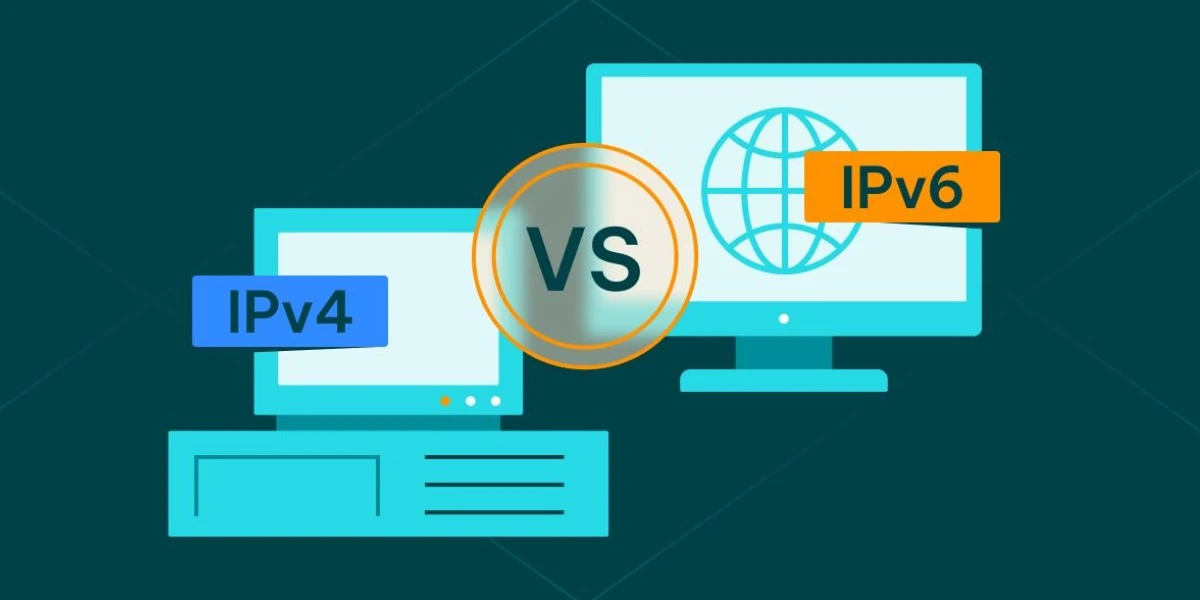
When you open a website, send an email, or connect to a server, the network needs to ‘know’ where to deliver the data and where to return the response. This is where IP addresses come in – unique network identifiers for nodes on the internet.
Domains simplify life for people: instead of memorising numbers, you enter an understandable name (for example, site.ua). DNS then converts this name into the server’s IP address, and a connection is established at this address. That is why IPv4 and IPv6 are always mentioned in connection with domains, DNS, and hosting – these are two versions of the addressing protocol that determine the format and capabilities of IP addresses.
An IP address (Internet Protocol address) is a unique address for a device or server on a network, which routers use to deliver data packets to the correct recipient. In simple terms, it is the ‘coordinates’ of a node on the Internet. When you enter a domain in your browser, DNS finds the IP address, and a request is sent to that address – this is the only way the network understands where to connect.
Separate from the IP is the port – the number of a specific service within the node. The IP answers the question ‘where to go,’ and the port answers ‘which service to contact.’ The same server can have one IP but serve many different services (web, mail, SSH) on different ports. For the web, 80 (HTTP) and 443 (HTTPS) are most often used, and for SSH, 22 is used.
IP addresses are assigned and managed at different levels: in a local network, they are usually distributed by a router (automatically via DHCP), and public addresses are assigned by an ISP or hosting provider (for servers, VPS, dedicated machines). In hosting, IP is important not only for accessing the site, but also for the correct operation of infrastructure elements: server management, DNS record settings, SSL/TLS, email reputation mechanisms, etc.
Most often, IP addresses are distinguished as follows:
The format of the address itself and the rules for its use are determined by the protocol version: IPv4 or IPv6. The version determines how the address looks, how many of them can exist, and what network capabilities are available ‘out of the box.’.
IPv4 (Internet Protocol version 4) is the fourth version of the Internet Protocol, which defines the rules for addressing and delivering packets on the network. IPv4 has been the basis of the Internet for decades and remains the most common IP address format for websites, servers, and provider networks.
IPv4 uses 32-bit addressing, so the total number of possible unique addresses is limited to approximately 4.3 billion. The address is written as four numbers from 0 to 255, separated by dots, for example: 203.0.113.10 or 192.168.0.1. In the context of hosting and domains, it looks like this: a domain in DNS most often points to an IPv4 address via an A record, and the browser connects to the server at that address.
The problem with IPv4 is that this version was created at a time when no one predicted the current scale: billions of smartphones, IoT devices, virtual machines, containers, and cloud services. Therefore, free public IPv4 addresses have become a scarce resource over time, and networks have begun to use address ‘saving’ techniques (the most famous being NAT) on a massive scale.
IPv4 is a mature and highly compatible protocol: it is supported by virtually all network equipment, operating systems, and provider networks. That is why it still dominates the Internet and remains the default option for hosting and domains: most websites have an A record in DNS that points to the server’s IPv4 address.
The key technical features of IPv4 have developed historically. The protocol allows packet fragmentation along the route (routers can split a packet if it does not fit the MTU), uses ARP to determine MAC addresses in the local network segment, and addresses are configured manually or via DHCP. For many scenarios, this works reliably, but it adds layers of logic to the infrastructure and complicates the maintenance of large or dynamic networks.
The main limitation of IPv4 is the shortage of address space. 4.3 billion sounds like a lot, but there are significantly fewer public addresses due to service reserves and historical allocation rules, and the number of devices and services is constantly growing. That is why NAT is widely used, allowing many devices on a local network to access the Internet through a single public address.
This is invisible to the user, but NAT often becomes a source of complexity for the infrastructure: it violates the end-to-end principle, complicates transparent routing, makes it more difficult to organise direct incoming connections, and some services require additional configuration or workarounds.
Another practical disadvantage is that security is not an integral part of IPv4. Traffic protection is usually implemented on top of or alongside the protocol (VPN, TLS, optional IPsec), which requires additional architecture and control. IPv4 also historically uses broadcast mechanisms in local networks, which can create unnecessary load in large segments.
IPv4 works reliably, but as a platform for growth, it has long been ‘on the verge’: the Internet relies on a scarce resource of addresses and compromises such as NAT. This was the fundamental reason for the emergence of IPv6.

IPv6 (Internet Protocol version 6) is the next version of the Internet Protocol, created as a long-term replacement for IPv4. Its main task is to eliminate the shortage of addresses and lay the foundation for modern network principles: simpler routing, better scalability, and normal end-to-end architecture without constant dependence on NAT.
IPv6 uses 128-bit addressing, so the available address space has virtually no real limitations for the development of the Internet. The address is written in hexadecimal format, divided into blocks, for example: 2001:db8:85a3::8a2e:370:7334. The record can be shortened: sequences of zeros are compressed with ::, and extra zeros in blocks are omitted – this makes addresses more readable, although they are still longer than IPv4.
In conjunction with domains, IPv6 works just as logically as IPv4: a domain name in DNS can point to a server’s IPv6 address via an AAAA record. If the client (browser, application, bot) and network support IPv6, the connection will be made directly via IPv6. If not, IPv4 or compatibility mechanisms in the infrastructure are used. This explains why today it is common to set up a ‘dual stack’ where the same service is available over both IPv4 and IPv6.
IPv6 was designed as a protocol for a large, dynamic Internet, where there should be a sufficient supply of addresses and the network should be easier to route and scale. Compared to IPv4, it has a different design logic: fewer ‘historical layers’ and more emphasis on efficiency and automation.
Key features of IPv6:
The limitations of IPv6 are not related to its ‘weakness’ but to the reality of its implementation. IPv6 is not directly compatible with IPv4, so the transition requires infrastructure solutions: dual-stack (parallel support), tunnelling, or translation. Because of this, migration in large networks often turns into a project involving addressing planning, security policies, equipment upgrades, monitoring, and team training.
Another practical issue is uneven support: some providers, corporate networks, outdated devices, and software are still not fully ready for IPv6. As a result, IPv6 is already the standard ‘for the future,’ but in the real Internet, it often works alongside IPv4 rather than replacing it.
IPv4 and IPv6 perform the same basic role: they address nodes and ensure packet delivery on the network. The difference lies in how this is implemented. IPv4 is an older protocol with a small address space, which is why the internet relies on compromises such as NAT. IPv6 is architecturally newer: it has plenty of addresses to spare, fewer unnecessary mechanisms in local networks, simpler routing, and better scalability for modern infrastructure.
The difference is in how this is implemented in practice.
| Parameter | IPv4 | IPv6 |
|---|---|---|
| Address length | 32 bits | 128 bits |
| Address example | 203.0.113.10 | 2001:db8:85a3::8a2e:370:7334 |
| Number of possible addresses | ≈ 4.3 billion | ≈ 3.4 × 1038 |
| DNS record for a domain | A → IPv4 | AAAA → IPv6 |
| Address shortage | Yes, public addresses are limited | Practically none |
| NAT | Widely used | Not required by design |
| Address configuration | Manual or DHCP | SLAAC and/or DHCPv6 |
| Broadcasting in a LAN | Used (broadcast) | No broadcast; multicast is used |
| Packet fragmentation | Routers may fragment packets | Only the sender fragments |
| Neighbor discovery in a LAN | ARP | NDP (Neighbor Discovery) |
| Packet header | More complex; includes a header checksum | Simpler; no header checksum |
| QoS / traffic flow labeling | Limited protocol-level capabilities | Flow Label field for traffic flows |
| Security | IPsec is possible but not typical | IPsec is built into the architecture (usage is optional) |
The practical conclusion for domains and hosting is simple: if your domain has an A record, it points to IPv4; if it has an AAAA record, it points to IPv6. In modern infrastructure, both records are often configured so that the site is accessible to both customers who use IPv6 and those who still use IPv4. This is not a ‘choose one option’ situation, but a way to ensure maximum compatibility and stable access regardless of the user’s network.

The main advantage of IPv6 is that it removes the fundamental limitation of IPv4: the lack of addresses. But in practice, it’s not just ‘more combinations.’ The large address space changes the approach to building networks: instead of constant savings and complex NAT schemes, you can design infrastructure that is more straightforward, easier to understand, and scalable.
This is important for hosting and servers for several reasons. First, IPv6 allows you to assign unique addresses to services, virtual machines, containers, development and testing environments without fighting for every IPv4 address. Second, the ‘end-to-end’ logic returns: the client can access the server directly, without additional address translation layers, which reduces the number of network ‘bottlenecks’ and simplifies diagnostics.
From a technical standpoint, IPv6 provides more efficient network operation on a large scale: it has a simplified header, fewer unnecessary mechanisms in local segments (no broadcast), and fragmentation is not transferred to routers. As a result, network equipment can process traffic more easily, and infrastructure is easier to automate – thanks in particular to SLAAC and more logical addressing.
A separate advantage is its readiness for modern scenarios. Where the number of microservices, Kubernetes pods, isolated environments, and temporary instances is growing, IPv6 is a more natural fit for the idea of ‘everything scales quickly and extensively.’ That is why IPv6 support on the hosting side is not a marketing ‘check mark,’ but an infrastructure reserve for the future and a reduction in dependence on the scarce IPv4 resource.
To be honest, no protocol makes a network automatically secure by default. The level of protection is determined by how servers, firewalls, updates, network segmentation, access policies, and monitoring are configured. But there are architectural differences between IPv4 and IPv6 that affect how security is built.
In IPv4, security has historically not been part of the protocol. Encryption and authentication are typically implemented at higher levels (TLS/HTTPS, VPN, SSH) or with additional network solutions. Also, due to the widespread use of NAT, many incoming connections do not reach the end device directly. This is often perceived as protection, but in essence, NAT is not a security mechanism, but a way to save addresses. It can reduce the attack surface accidentally (because there is no direct access), but it can also mask problems in the architecture and complicate traffic control.
In IPv6, IPsec support is provided by the protocol architecture. An important nuance: this does not mean that all IPv6 traffic is automatically encrypted. IPsec usually needs to be configured, and in real life, web encryption is still done via TLS. However, the very readiness of the protocol for end-to-end protection is a plus, especially in corporate scenarios and networks with clear policies.
There is another side to this. Due to the lack of need for NAT, nodes in IPv6 more often receive globally routed addresses, which means that they can theoretically be more ‘visible’ from the outside. This is not a problem if the firewall is configured correctly and unnecessary ports are closed, but it does require a disciplined approach to access policies. Additionally, during the transition period, risks may be increased by ‘mixed’ infrastructure: dual-stack, tunnels, and IPv4/IPv6 translation, if they are not configured correctly.
The practical conclusion is that security is determined not by the IP version, but by the configuration. IPv6 provides a better foundation for modern network architecture and lays the groundwork for end-to-end protection, but it requires the same (or more) attention to firewalls, access rules, and service control as IPv4.

Yes, but not in the sense that is usually imagined as the ‘successor to IPv4.’ IPv5 was used as the version number for the experimental Internet Stream Protocol (ST), which was developed in the 1980s for real-time data transmission (streaming video/voice) with more predictable delivery characteristics. It was a separate branch of development for specific tasks, not a universal replacement for IPv4 for addressing the entire Internet.
The protocol never gained widespread adoption in network equipment and software stacks. When it came time to create a full-fledged successor to IPv4 to solve the problem of address shortage and network scaling, the number ‘5’ was already considered taken, so the next version standard was immediately established as IPv6.
An IP address is the technical basis of any Internet connection, while domains and DNS simply make access to resources convenient for people by converting an understandable name into a numerical server address. That is why it is critical for hosting to understand what is behind a domain in DNS: an A record leads to IPv4, an AAAA record leads to IPv6, and in practice, the most reliable approach today is to support both options where appropriate.
IPv4 remains the most common, but its address space has long been a scarce resource, giving rise to compromises such as NAT. IPv6 solves this problem at the architectural level and is better suited to the modern scale of the internet: clouds, microservices, containers, and a large number of devices. The full transition will take time, but the direction is clear: the internet is moving towards a model where IPv6 becomes the default standard and IPv4 gradually becomes a legacy that will have to be supported for a long time to come.
Response

We have been cooperating with Hostpark for several years. We are very pleased with the highly coordinated work! The company always provides quality services and offers favorable conditions. The technical support team responds quickly to requests and, if necessary, provides consultations and explanations. If you have any technical issues, the specialists solve everything promptly! We can safely recommend it.
Sincerely, Mykhailo Savinov, Director of Astelit LLC

AVA Group recommends Hostpark as a reliable partner that has been tested by time. You always stand up for your client's interests, and this is very gratifying. We wish you development and prosperity!
Sincerely, Maxym Shevchuk, President of AVA Group

CFJ Trading LLC expresses its gratitude to HOST PARK GROUP LLC for the successful implementation of the project on the introduction of a new virtual infrastructure hosting based on the Atman data center. Over the three years of cooperation, HOST PARK GROUP LLC has proved to be an expert in its field, with certified engineers and qualified technical specialists involved in the projects. The specialists of HOST PARK GROUP LLC actively participated in the design, construction of infrastructure in accordance with the project requirements, in the development and expansion of the data center, and in its active support. Engineering support in the data center itself was provided in a timely manner and at the appropriate professional level, and the implementation of new capacities was carried out with the highest quality and in the shortest possible time. We would like to note the high professional level of the specialists of HOST PARK GROUP LLC and thank them for the prompt and high-quality implementation of the project. All works were completed in full in accordance with the contractual obligations and terms of reference and in compliance with the deadlines. We look forward to further fruitful cooperation.
Sincerely, V.Yu. Cherniavskyi, Director of Business Development and Support Department, CFJ Trading LLC

Relocating a data center to another facility within Ukraine was already a challenging task even in peacetime. Moving it abroad, and under wartime conditions, was an even greater challenge. However, thanks to the Hostpark team, we were able to complete this process as smoothly and painlessly as possible. UNIVERSAL BANK is a major Ukrainian retail bank. Nearly 10 million citizens of Ukraine are our clients and loyal users of our mobile application, monobank. Ensuring uninterrupted access to our customers’ funds has always been our highest priority. However, with the onset of the full-scale war, fulfilling this task became extremely difficult — all of our data centers were located within Ukraine and were exposed to significant risks. As a result, a decision was made to quickly establish a fully operational data center within the European Union, using the network and server equipment already at our disposal. To accomplish this task, we required a competent partner with experience operating both in Ukraine and in the EU — and such a partner for us was HOSTPARK. The teams of UNIVERSAL BANK and HOSTPARK carefully developed a plan to relocate part of the Bank’s critical IT infrastructure from Ukraine to the EU, selected a suitable location for the equipment within the EU, resolved all related customs and organizational matters in both Ukraine and the EU, and successfully executed the migration plan while avoiding downtime and maintaining full control over the process. Currently, our equipment is hosted in one of the EU countries in a specialized data center that meets the highest industry standards. Our data centers in Ukraine and the EU are connected via high-capacity data transmission channels (with HOSTPARK once again acting as one of the providers). Over an extended period of operation, we have proven the reliability of this infrastructure in practice. We would also like to highlight the continuous support provided — we were always in close contact with the HOSTPARK team, and all issues were resolved promptly and professionally. We sincerely recommend HOSTPARK as a reliable partner for organizations seeking to ensure the highest level of stability and security for their IT infrastructure.
Yours sincerely,
Acting Chairman of the Management Board
JSC “UNIVERSAL BANK” Valerii ZADOROZHNYI












Ask us and our managers will contact you as soon as possible.