Cabinet
24/7 Support
24/7 Support

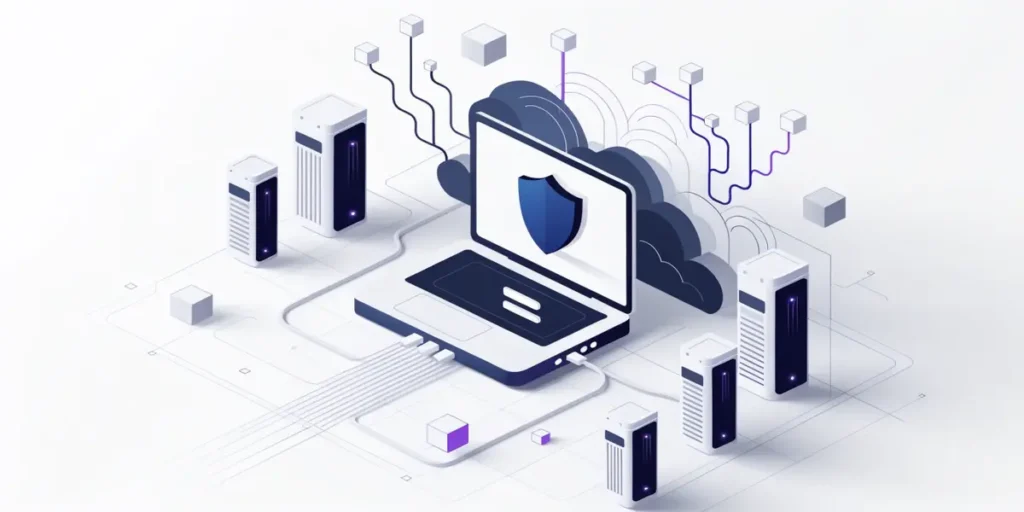
When a user opens a website, launches a mobile application, or pays for an online purchase, all these actions pass through an invisible infrastructure, at the heart of which is a data center. This is where terabytes of information are stored, processed, and protected, without which the modern Internet and digital business simply could not exist.
A modern data center is not just a room with servers, but a complex technological complex with redundant power supply, a well-designed cooling system, multi-level security, and high-speed network connections. Thanks to the company’s data centers in any country, including businesses that work with data centers in Ukraine and abroad, they can ensure stable 24/7 service operation, scale up for peak loads, and meet cyber security requirements.
Understanding what a data center is, how it is organized internally, and why it is often called the “heart of the Internet” helps businesses make informed choices about infrastructure partners and make technically sound decisions. This article takes a detailed look at how a data center is not just a place to house equipment, but also a comprehensive ecosystem of services that ensure the continuity of digital processes.
A data center, or DC (data processing center), is a specialized facility that houses powerful servers, storage systems, and network equipment for centralized management of digital resources. A data center is a comprehensive solution that provides storage for huge amounts of data, real-time processing, and uninterrupted transmission via the Internet to end users around the world.
The role of a data center is to become a reliable hub for business: from cloud platforms and websites to corporate databases and streaming video. A data center is the heart of modern IT infrastructures, where data is not just stored on disks, but actively processed by processors, duplicated for fault tolerance, and transmitted with minimal delay thanks to fiber optic channels and CDN technologies.
What is a data center in the context of Ukrainian business? It is a data center in Ukraine or abroad that guarantees compliance with local GDPR and DSGVO regulations, high-speed access to European networks, and integration with global services, allowing companies to focus on development rather than technical maintenance.
The history of data centers, or DCs (data processing centers), dates back to the 1940s, when the first ENIAC computer appeared at the University of Pennsylvania for the needs of the US Army — a giant machine weighing 27 tons, occupied an entire room and required a separate, air-conditioned room for ballistic calculations. At that time, data centers were primitive server rooms without backup power or automated climate control, where equipment often failed due to overheating or power surges.
In the 1950s and 1960s, large corporations such as IBM and Burroughs began building commercial data centers for mainframes that processed banking transactions and scientific calculations; this was a transition from isolated machines to centralized systems with the first elements of networking and ventilation. The 1970s and 1980s brought microprocessors and personal computers, which stimulated the creation of network server rooms in companies, and in the 1990s, the Internet boom, when data centers turned into colocation centers — scalable complexes with fiber optics, RAID arrays, and the first UPS systems.
The modern era, beginning in the 2000s, has been marked by the emergence of hyperscale data centers from Google, Amazon, and Microsoft, with modular architecture, AI optimization, and green technologies. In Ukraine, data centers have evolved from local server cabinets to TIER III-certified facilities, where universal data centers are integrated with European clouds for global business resilience.
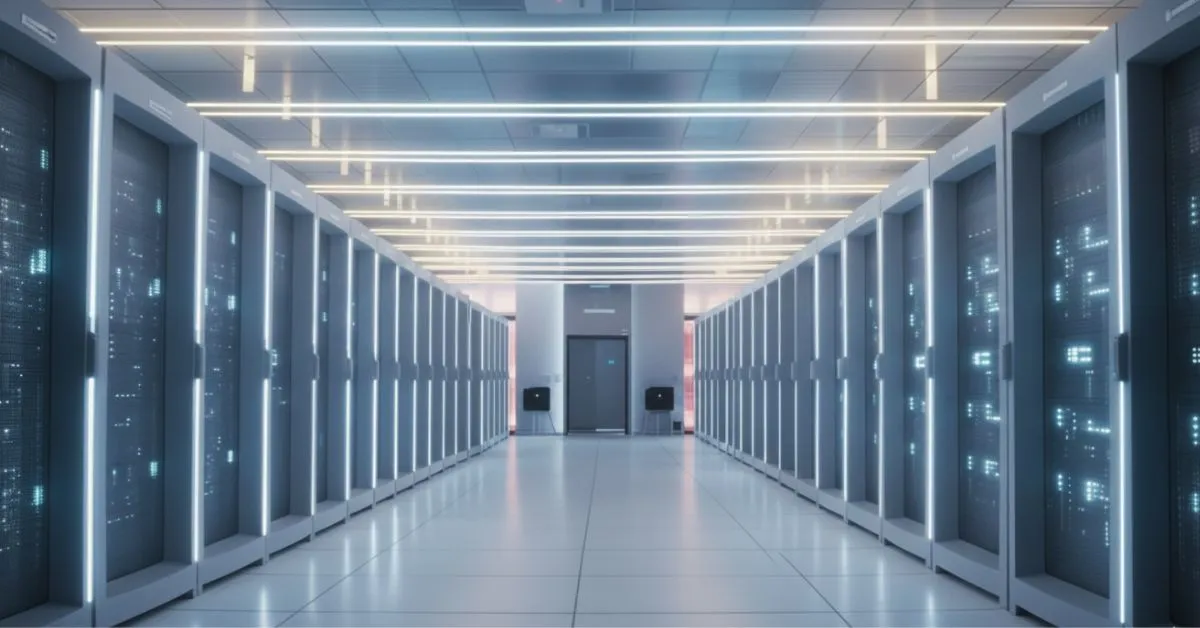
Data centers, or DCs, are classified according to several criteria: purpose (who they are built for), architecture (equipment structure), and service delivery model, which allows businesses to choose the optimal type depending on their scale, budget, and tasks. Corporate data centers are created by large companies for internal use — they host ERP systems, employee databases, or corporate CRMs, with a high level of isolation and compliance with standards such as ISO 27001.
Commercial data centers are focused on providing services to third parties: colocation (placing client servers in racks), leasing entire servers or rack space, which is ideal for medium-sized businesses that want to avoid capital expenditures on their own infrastructure. Cloud data centers (e.g., from AWS, Google Cloud, or local providers) operate on IaaS, PaaS, and SaaS models, where the data center is a virtualized ecosystem with APIs for dynamic scaling of CPU, RAM, and storage resources.
In Ukraine, universal data centers often combine commercial and cloud models, ensuring local compliance with regulations and integration with European networks for business.
A data center, or DC, functions as a high-speed data conveyor: the process begins with a request from a user via the Internet, which is sent to a load balancer — a device that distributes traffic between servers to avoid overloads. The request is routed to the appropriate web server or application layer, where the data center is a complex system that processes HTTP/HTTPS requests, executes SQL queries to databases, and generates dynamic content.
Next, data is extracted from storage systems (SAN/NAS or object storage such as S3), processed on computing nodes with CPU/GPU, and for complex tasks, Kubernetes containers or virtual machines are used; The entire flow is controlled by SDN (software-defined networks) to optimize routing. The result is formed in response — an HTML page, JSON, or file — and sent back to the user via CDN nodes with caching for minimal delay, ensuring a cycle in milliseconds.
In real time, the data center in Ukraine monitors the entire process through NMS systems (such as Zabbix or Prometheus), automatically redistributing the load during peaks and duplicating data for fault tolerance, making the data center the heart of continuous online services.
A data center, or DC (data processing center), solves key tasks of modern digital business, ensuring 24/7/365 service continuity thanks to backup power systems, equipment redundancy, and automatic failover to failover nodes during failures. Continuity is the main function, where the data center is a reliable foundation for e-commerce, banking systems, or streaming, with an SLA of 99.99% and above.
Information storage in the data center is implemented through SSD/HDD arrays with RAID, object storage, and cloud archives, allowing for scaling from terabytes to exabytes with automatic backup and disaster recovery (DRaaS). Network operations include 100Gbps+ traffic routing, load balancing, and CDN integration for global content delivery with minimal latency.
Security is another critical task: the data center is a multi-level shield with firewalls, DDoS protection, data encryption at rest/in transit, biometric access, and GDPR/ISO 27001 compliance, protecting businesses from cyber threats and ensuring confidentiality for customers in Ukraine and abroad.
A data center, or DC (data processing center), has a modular technical structure that includes physical infrastructure, computing resources, and support systems, ensuring uninterrupted operation as a data center. Key modules—server rooms, networks, power, and cooling—work in sync, where the data center is an integrated ecosystem with automated monitoring for maximum efficiency.
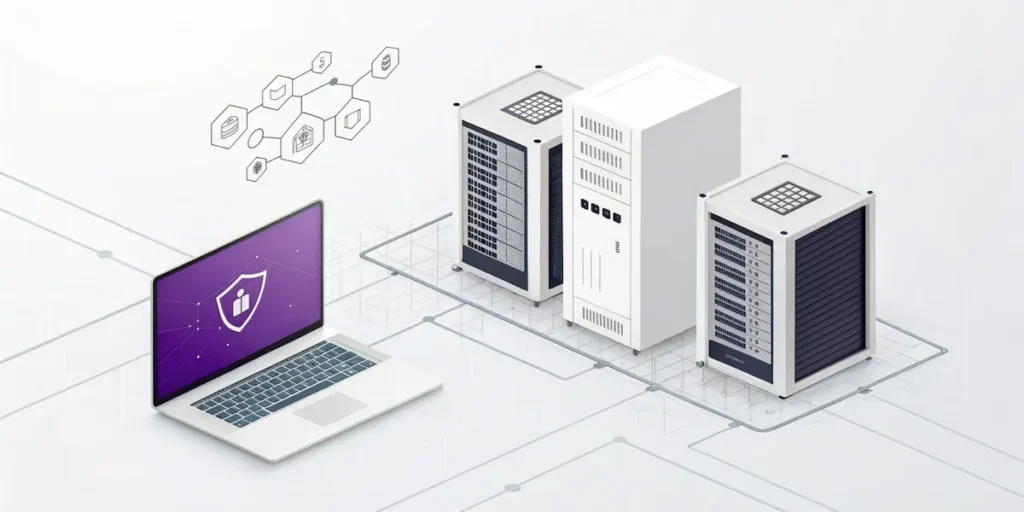
Server rooms in the data center are equipped according to TIER standards, with raised floors for cables and ventilation, 42U racks where equipment is mounted vertically with a density of up to 20-40 kW per rack. Structured cabling systems use trays, tracks, and color coding for quick access, while hot/cold aisle containment optimizes airflow by separating heated and cooled air zones.
The placement of equipment takes into account weight (up to 1,000 kg/rack), seismic resistance, and accessibility: equipment is mounted on rails with PDUs for power supply, and automated doors with biometrics restrict entry, providing the data center in Ukraine with a high level of physical security.
Computing servers (rack/blade) process requests on CPU/GPU/TPU, virtualizing resources through VMware or KVM for multitasking. Network devices — Cisco/Juniper switches at 100/400 Gbps, SDN controllers, and firewalls — provide routing, VLAN, and QoS, while storage systems (SAN, NAS, Ceph) combine SSD for speed and HDD for volume with data replication.
In the data center, servers, networks, and storage form a single chain: requests go through load balancers to applications, data is read in parallel, and SDN dynamically optimizes traffic, making the data center the basis for scalable services.
Uninterruptible power supply is provided by transformers, UPS (dual with 15-60 min batteries), auto-start diesel generators, and DC batteries for critical loads. Cooling is provided by CRAC/CRAH units, chillers with PUE <1.5, free cooling, and liquid cooling for HPC, maintaining 18-27°C and 40-60% humidity.
Security includes gas fire suppression (Novec 1230), smoke/VESDA detectors, 24/7 video surveillance, biometrics, and mantraps; all monitored by DCIM systems for proactive response, ensuring the stability of the universal data center.
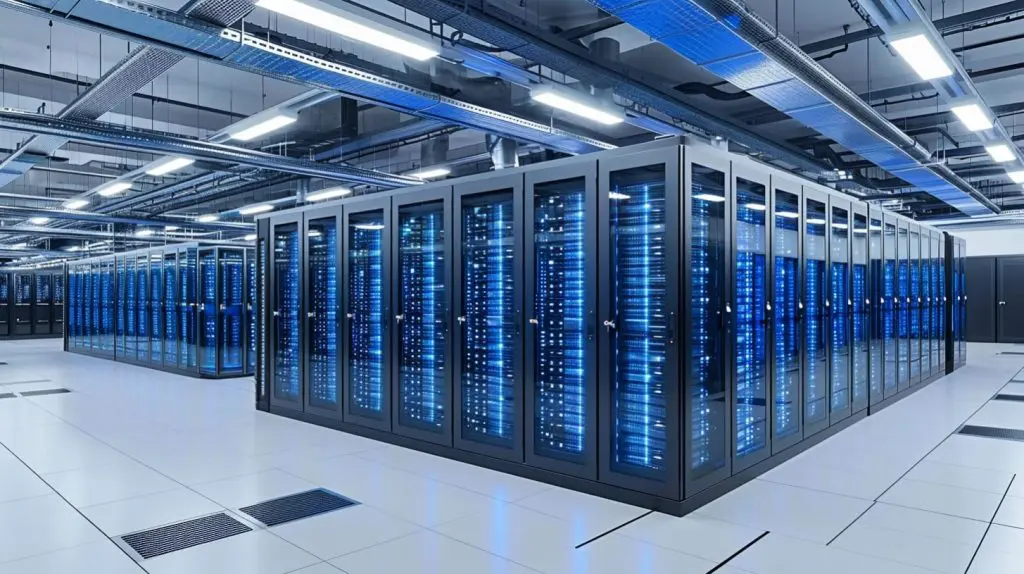
TIER reliability levels are a classification standard developed by the Uptime Institute that determines the degree of fault tolerance of a data center based on criteria such as redundancy, downtime, and service availability, with higher levels guaranteeing a lower probability of failure. Each level from TIER I to TIER IV differs in its redundancy scheme (N, N+1, 2N+1), allowing for non-stop maintenance, which is critical for data centers.
Level
Reservation
Downtime/year
Availability
Service stability
| TIER I | N (basic) | 28.8 hours | 99.671% | Basic, failures during any maintenance; for small businesses without critical requirements. |
| TIER II | N+1 (partial) | 22 hours | 99.741% | Redundant power/cooling, but downtime during repairs; suitable for medium-sized companies. |
| TIER III | N+1 (full) | 1.6 hours | 99.982% | Competitive service without downtime, backup routes; standard for e-commerce and banks. |
| TIER IV | 2(N+1) (dual) | 0.4 hours | 99.995% | Full fault tolerance, sectioned systems; for mission-critical services such as government agencies. |
In the context of data centers in Ukraine, most are TIER III certified, where the data center provides an SLA of 99.982% for business process stability with minimal risks.
Modern data centers, or DCs, offer a wide range of services for businesses, from physical equipment hosting to complete cloud outsourcing, allowing companies to optimize costs and focus on core tasks. Key services include colocation, where customers place their own servers in data center racks with access to power, cooling, and networking.
Hostpark integrates these services with European partners, ensuring low latency and local support for businesses.
A data center, or DC (data processing center), is indispensable for business because it provides scalability: companies can dynamically expand CPU, RAM, and storage resources during peak loads, such as Black Friday in e-commerce, without purchasing their own equipment. This allows you to avoid CapEx and switch to a pay-as-you-go OpEx model, optimizing your budget.
Business continuity is achieved through 99.99%+ SLA, backup power systems, and geo-replication, where the data center guarantees 24/7 operation of CRM, online stores, or financial platforms, minimizing downtime losses (which reach $5k/min for an average business). Security is implemented through multi-level protection — from physical access to encryption and DDoS filtering, ensuring GDPR compliance and customer data protection.
For Ukrainian businesses, data centers serve as a bridge to global markets, combining local speed with European infrastructure, making them a key factor in competitiveness in the digital age.
When choosing a data center, or DC, businesses should evaluate key criteria, starting with reliability: look for TIER III/IV certification with an SLA of at least 99.982%, which guarantees minimal downtime and service continuity. Uptime Institute, ISO 27001, or PCI DSS certification confirms compliance with global standards of quality and fault tolerance.
Security includes multi-layered protection — biometrics, video surveillance, DDoS mitigation, and encryption, with regular audits and GDPR compliance for data protection; check incident reports and response protocols. 24/7 support with an SLA response time of <15 minutes, technical SLAs, and a localized team (e.g., Ukrainian) are critical for quick problem resolution.
The geography of the data center in Ukraine or Europe affects latency: choose connection points with UA-IX, DE-CIX for low latency, and energy efficiency (PUE <1.5) reduces costs and environmental impact through free cooling and LED lighting. A universal data center takes all these factors into account for an optimal price/quality ratio.
Inside, a data center is a high-tech ecosystem where a data processing center (DPC) stores, processes, and transmits information, making it the true heart of the internet for businesses of all sizes. From the evolution of the first server rooms to modern TIER-certified complexes, data centers guarantee scalability, continuity, and security, allowing companies to focus on innovation rather than infrastructure.
Key services — colocation, cloud solutions, and cyber security — make data centers a universal tool for growth, especially in Ukraine, where providers such as Hostpark integrate local businesses in Ukraine with European data centers (e.g., Atman) for global competitiveness and low latency. When choosing a provider, pay attention to reliability, certification, and PUE to ensure the stability of business processes in the digital age.
Response

We have been cooperating with Hostpark for several years. We are very pleased with the highly coordinated work! The company always provides quality services and offers favorable conditions. The technical support team responds quickly to requests and, if necessary, provides consultations and explanations. If you have any technical issues, the specialists solve everything promptly! We can safely recommend it.
Sincerely, Mykhailo Savinov, Director of Astelit LLC

AVA Group recommends Hostpark as a reliable partner that has been tested by time. You always stand up for your client's interests, and this is very gratifying. We wish you development and prosperity!
Sincerely, Maxym Shevchuk, President of AVA Group
CFJ Trading LLC expresses its gratitude to HOST PARK GROUP LLC for the successful implementation of the project on the introduction of a new virtual infrastructure hosting based on the Atman data center. Over the three years of cooperation, HOST PARK GROUP LLC has proved to be an expert in its field, with certified engineers and qualified technical specialists involved in the projects. The specialists of HOST PARK GROUP LLC actively participated in the design, construction of infrastructure in accordance with the project requirements, in the development and expansion of the data center, and in its active support. Engineering support in the data center itself was provided in a timely manner and at the appropriate professional level, and the implementation of new capacities was carried out with the highest quality and in the shortest possible time. We would like to note the high professional level of the specialists of HOST PARK GROUP LLC and thank them for the prompt and high-quality implementation of the project. All works were completed in full in accordance with the contractual obligations and terms of reference and in compliance with the deadlines. We look forward to further fruitful cooperation.
Sincerely, V.Yu. Cherniavskyi, Director of Business Development and Support Department, CFJ Trading LLC

Relocating a data center to another facility within Ukraine was already a challenging task even in peacetime. Moving it abroad, and under wartime conditions, was an even greater challenge. However, thanks to the Hostpark team, we were able to complete this process as smoothly and painlessly as possible. UNIVERSAL BANK is a major Ukrainian retail bank. Nearly 10 million citizens of Ukraine are our clients and loyal users of our mobile application, monobank. Ensuring uninterrupted access to our customers’ funds has always been our highest priority. However, with the onset of the full-scale war, fulfilling this task became extremely difficult — all of our data centers were located within Ukraine and were exposed to significant risks. As a result, a decision was made to quickly establish a fully operational data center within the European Union, using the network and server equipment already at our disposal. To accomplish this task, we required a competent partner with experience operating both in Ukraine and in the EU — and such a partner for us was HOSTPARK. The teams of UNIVERSAL BANK and HOSTPARK carefully developed a plan to relocate part of the Bank’s critical IT infrastructure from Ukraine to the EU, selected a suitable location for the equipment within the EU, resolved all related customs and organizational matters in both Ukraine and the EU, and successfully executed the migration plan while avoiding downtime and maintaining full control over the process. Currently, our equipment is hosted in one of the EU countries in a specialized data center that meets the highest industry standards. Our data centers in Ukraine and the EU are connected via high-capacity data transmission channels (with HOSTPARK once again acting as one of the providers). Over an extended period of operation, we have proven the reliability of this infrastructure in practice. We would also like to highlight the continuous support provided — we were always in close contact with the HOSTPARK team, and all issues were resolved promptly and professionally. We sincerely recommend HOSTPARK as a reliable partner for organizations seeking to ensure the highest level of stability and security for their IT infrastructure.
Yours sincerely,
Acting Chairman of the Management Board
JSC “UNIVERSAL BANK” Valerii ZADOROZHNYI











Ask us and our managers will contact you as soon as possible.