

Cloud technologies are used to operate corporate systems, databases, internal portals, analytics platforms, backup solutions, and software development and testing environments. However, not every business is suited to a model in which a cloud platform serves many independent customers. If a company needs a separate and controlled environment for its IT systems, a private cloud may be one of the available options.
A private cloud environment combines the principles of cloud computing with resources dedicated to the needs of a single organisation. A company can centrally manage computing capacity, storage, virtual machines, networks and access permissions. A private cloud does not necessarily have to be located in the company’s own office or data centre. It can be deployed either on the organisation’s premises or on infrastructure operated by an external provider.
This approach may be appropriate when configuration control, environment segmentation, integration with the corporate network, a specified data location or particular IT architecture requirements are important. To assess whether the solution is suitable, it is necessary to understand not only what cloud technologies are in general, but also the differences between a private cloud, a VPC, and public and hybrid cloud models.
What Is a Private Cloud?
A private cloud is cloud infrastructure provisioned for the exclusive use of a single organisation. Its resources may be used by different departments, teams or internal systems, but the environment itself is created for that organisation. It may be managed by the company, an external provider or both parties under an agreed division of responsibilities.
This definition corresponds to the classification in NIST Special Publication 800-145. NIST states that a private cloud may be owned and managed by the organisation, a third party or a combination of both, and that its infrastructure may exist on or off the organisation’s premises. The physical location of the equipment is therefore not the sole defining characteristic of a private cloud.
A private cloud should not be equated with a single dedicated server. A dedicated server may form part of such an architecture, but the cloud model involves a pool of computing, storage and network resources, centralised management, virtualisation and the ability to allocate capacity to individual workloads without permanently tying every system to a particular physical server.
It is equally important to distinguish a fully dedicated private cloud from a VPC, or Virtual Private Cloud. With a VPC, the customer receives a logically isolated virtual network and can control its addressing, routes, subnets and access rules, while the physical platform may still serve several customers. The official AWS documentation, for example, defines a VPC as a logically isolated virtual network.
The name of a service should not automatically be interpreted as a guarantee of dedicated physical servers, network equipment or storage systems. If hardware isolation is critical to a project, dedicated hardware must be specified separately in the architecture, technical specification and contract.
Privacy does not automatically provide protection against every cyber risk. Security depends on network segmentation, identity and access management, updates, account protection, logging, monitoring, backup, and the configuration of operating systems and applications. A private model primarily gives an organisation greater control over its architecture and policies, but those controls must be implemented correctly and monitored continuously.
Hostpark offers a dedicated commercial solution called VMware Private Cloud. When selecting such a platform, a business should assess more than the marketing name. It must review the actual environment configuration, available resources, degree of logical or physical isolation, management model, storage characteristics, network capabilities, redundancy, backup, SLA terms and the limits of the provider’s responsibility.
How Does a Private Cloud Work?
A private cloud is built on physical infrastructure consisting of servers, data storage systems and network equipment. A software-defined virtualisation and management layer operates above this infrastructure, combining the resources into a single environment and distributing them among virtual machines and other workloads.
Virtualisation plays a central role. The hypervisor abstracts virtual resources from specific physical hardware. A virtual machine can be assigned processor capacity, memory, disk space, network interfaces and other parameters. In a cluster architecture, this makes it possible to distribute workloads among several physical nodes and use the available capacity more efficiently.
A typical private cloud environment may include the following layers:
- Computing resources. Physical servers provide CPU and memory for virtual machines, containers and other workloads. Actual performance depends on processor models, node architecture, reservation policies and the permitted level of overcommit.
- Data storage systems. Disk arrays or software-defined storage are used for system disks, databases, files and virtual machine images. An assessment should consider not only available capacity but also latency, IOPS, throughput, fault tolerance and available storage classes.
- Network infrastructure. Switches, routing, VLANs, virtual networks, VPNs and filtering rules provide communication between components and control traffic. The network architecture should be designed around external integrations, administrative access and the need for redundant connections.
- Virtualisation layer. The hypervisor creates and isolates virtual environments and distributes the resources of the physical cluster among them. Its functionality depends on the selected platform, licences, software version and enabled components.
- Management platform. Administrators create virtual machines, modify configurations, configure networks and monitor resource consumption through a control panel, API or automation tools. API availability is particularly important for Infrastructure as Code, automated deployment and integration with corporate processes.
- Security and continuity tools. Firewalls, encryption, logging, backup, replication, monitoring and disaster recovery can be added to the architecture as required. Their availability, parameters and responsible parties depend on the specific configuration and contract.
As a result, physical servers are no longer treated as separate and independent machines for every individual task. The administrator works with a managed pool of resources and can create new virtual environments, modify their configuration or remove them after a project has been completed. This does not eliminate the physical limitations of the infrastructure, but it allows the available capacity to be allocated more efficiently.
The network layer is particularly important. A corporate environment can separate administrative, internal and external traffic, establish individual segments for databases, applications or test systems, and define access rules between them. For additional perimeter protection, Hostpark separately offers Atman Firewall. This is an independent network service and should not be assumed to be automatically included with every private cloud.
Storage must also be selected according to the type of workload. Transactional databases may require consistently low latency, a high number of input and output operations and stable performance during peak periods. Archives, backup sets and large volumes of static files have different requirements. Hostpark separately provides Object Storage on Atman infrastructure with access through compatible S3 and Swift protocols. This is a separate object storage service, not a mandatory storage layer of the VMware private cloud.
The actual flexibility of a private environment depends on its architecture and available spare capacity. If the existing pool has free CPU, RAM and storage, the configuration of a virtual machine can be increased or a new VM can be created without purchasing a separate server. If the physical resources have been exhausted, the cluster must be expanded or the ordered configuration must be changed. Some scaling operations may also require a scheduled maintenance window or workload migration.
What Types of Private Cloud Are Available?

A private cloud is a distinct cloud infrastructure deployment model, but in practice its implementation is often described according to the location of the equipment and the method of administration. The terms on-premises, hosted and managed therefore describe different aspects of a solution and may overlap.
On-Premises Private Cloud
An on-premises private cloud is deployed on infrastructure belonging to the organisation. The servers, storage and network equipment are located on its premises or in its own data centre, while the company controls both the physical platform and the cloud software.
This option provides direct control over the equipment, but it also makes the company responsible for power, cooling, physical security, communication links, spare components, platform updates, monitoring and the engineering team. An economic comparison must therefore consider not only the purchase of servers but also their total operating cost throughout the planned service life.
An on-premises model may be justified for organisations with mature internal IT infrastructure, specific physical placement requirements, a need for low latency to local equipment or significant existing investment in a data centre. However, local deployment does not automatically guarantee stronger security or higher availability.
Hosted Private Cloud
A hosted private cloud is deployed in an external provider’s data centre. The business does not need to create and maintain its own server room, cooling systems, backup power supply or external network infrastructure. The general principles behind professional facilities are explained in the Hostpark article about how a data centre works.
A hosted private cloud should not automatically be interpreted as a separate physical cluster. A particular implementation may use dedicated hardware, a reserved resource pool or another isolation model. The degree to which servers, networks and storage are dedicated must be defined in the technical specification for the service.
The advantage of the hosted approach is that the company can transfer responsibility for the physical infrastructure and some operational tasks to the provider while retaining the required level of control over the virtual environment. However, the customer should verify the data location, facility certifications, physical access rules, network availability, maintenance procedures and the conditions for returning or deleting data after the contract ends.
Managed Private Cloud
A managed private cloud primarily describes an administration model rather than a particular physical deployment type. The environment may be hosted or even located on the customer’s infrastructure, while some technical operations are performed by an external provider.
The scope of managed services depends on the contract. It may cover support for the virtualisation platform, monitoring, network infrastructure, updates to specified components, capacity management or other operations. Administration of guest operating systems, databases and business applications may still remain the customer’s responsibility.
The contract should specifically state who installs updates, responds to alerts, manages user accounts, restores data, tests backups and addresses vulnerabilities inside virtual machines. Without this distinction, the term managed may create a false expectation that the provider is fully responsible for every layer of the system.
Hybrid architectures are also available, in which a private environment interacts with a public cloud or other infrastructure. Hostpark provides Atman Cloud Connect for establishing dedicated connections to resources in AWS, Google Cloud or Microsoft Azure. This is a separate data connectivity service that can be used as part of a hybrid or multi-cloud architecture.
Advantages and Disadvantages of a Private Cloud
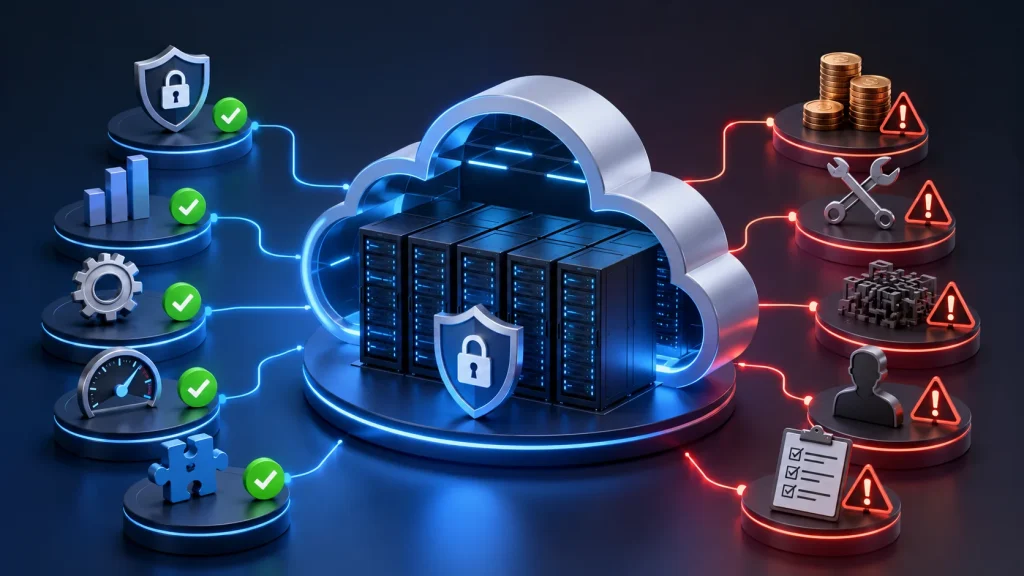
A private cloud is not universally better than a public cloud. Its suitability depends on workload characteristics, budget, isolation requirements, configuration, data location and the expertise of the IT team. A dedicated environment may solve critical architectural challenges for one business while creating unnecessary complexity and expense for another.
Control Over the Architecture
A private environment allows an organisation to define the resource configuration, network topology, segmentation rules, access models, storage requirements and other parameters more precisely. This is important for systems with non-standard integrations, specialised software or particular corporate standards.
However, wider configuration options increase the number of decisions for which the organisation must be responsible. The architecture must be documented, controlled, updated and verified after changes. Without standardisation and automation, a private environment can accumulate configuration inconsistencies and technical debt.
Resource Isolation and Security
One reason for using a private cloud is the need for a separate environment for the systems of a single organisation. However, the actual isolation level must be assessed. A logically isolated VPC on a shared hardware platform and a private cloud based on dedicated hardware are different architectural models.
Neither model provides security automatically. Compromised accounts, incorrect permissions, vulnerable applications, missing updates, configuration errors, insufficient segmentation and an inadequate backup strategy remain potential risks. Private cloud should be treated as one layer of the architecture, not as a substitute for systematic information security management.
Greater control also creates greater responsibility. If the customer independently manages networks, virtual machines and operating systems, an administrative error may negate the advantages of the dedicated environment. Critical platforms require multi-factor authentication, least-privilege access, logging of administrative actions and regular access reviews.
Scaling
Within an existing resource pool, virtualisation makes it possible to change VM configurations and create new environments without installing a separate physical server for each task. This simplifies infrastructure development compared with a model in which every system is permanently tied to its own hardware.
A private cloud nevertheless has physical limits. If the available CPU, RAM or storage has been exhausted, the infrastructure must be expanded. This may involve ordering additional equipment, adding nodes, purchasing licences or modifying the service configuration. Claims of unlimited or instantaneous scaling are therefore inaccurate unless they are supported by the architecture and contractual terms of a specific service.
Resource Predictability
A dedicated or reserved pool makes it possible to plan infrastructure for a particular workload and reduce dependence on the behaviour of other customers at those layers that are isolated by the chosen architecture. This can be important for ERP systems, databases, VDI and other corporate platforms.
Predictable performance depends not on the word private, but on the CPU, storage and network parameters, overcommit policies, redundancy model and platform behaviour when nodes fail. These characteristics should be assessed in the technical specification and verified through load testing before critical systems are migrated.
Cost and Complexity
A private cloud usually involves reserving or dedicating a certain amount of infrastructure to one customer, so its economics differ from those of a large-scale public cloud. For an on-premises deployment, costs include equipment, licences, electricity, cooling, networking, physical security, spare components and personnel. In a hosted model, a significant proportion of these expenses is transferred to the provider’s service charges.
The assessment should cover the total cost of ownership, including computing resources, storage, licences, network services, backup, technical support, migration, administration, team training and future expansion. Comparing CPU and RAM prices alone is insufficient because some components may be billed separately in different offers.
The Need for Competent Administration
Private infrastructure requires management of the virtual machine lifecycle, access, networks, performance, capacity, updates and operational continuity. A provider may perform some of these tasks, but the division of responsibilities must be defined in the contract.
Backup must be planned separately. The presence of a cloud platform does not mean that independent copies of data are created automatically. Hostpark offers separate cloud backup services, including solutions based on Veeam and Atman BaaS. For critical systems, the organisation must define a backup policy, backup frequency, retention period, protection against deletion and a procedure for regularly testing recovery.
How Does a Private Cloud Differ from a Public Cloud?
The main difference concerns the infrastructure usage model. A private cloud is provisioned for the exclusive use of one organisation, whereas a public cloud platform serves many independent customers and uses tenant isolation mechanisms to separate their environments.
This does not mean that a private cloud is automatically safer or that a public cloud is less reliable. Security, availability and performance depend on the actual architecture, technologies, configuration, operating procedures and service terms.
| Criterion | Private cloud | Public cloud |
|---|---|---|
| Usage model | The environment is provisioned for the exclusive use of one organisation. | The platform provides resources to many independent customers. |
| Isolation | The degree of isolation depends on the implementation, ranging from a logically private environment to dedicated infrastructure. | Customer environments are logically isolated within the provider’s shared platform. |
| Control | Usually offers greater scope for adapting networks, resources and policies to corporate requirements. | The customer works within the capabilities, quotas and rules provided by the particular platform. |
| Scaling | Can be fast within the available pool, but expansion of the physical platform may require additional resources and time. | A substantial shared provider pool is usually available, but actual limits depend on the region, service and assigned quotas. |
| Cost model | Often connected to a dedicated or reserved configuration and the cost of supporting it. | May use subscriptions, pay-as-you-go, reservations or other models according to the provider’s terms. |
| Management | May be performed by the customer, the provider or both parties under an agreed model. | The provider manages the underlying platform, while the customer is responsible for its resources and data under the shared responsibility model. |
| Backup and DR | Must be designed separately or explicitly included in the contract. | Should not be assumed to be included automatically without reviewing the terms of the particular service. |
An example of a public model in the current Hostpark service portfolio is Atman Cloud. The platform is based on OpenStack and operates as a shared public cloud in which customers receive separate virtual environments on shared infrastructure.
Commercial terminology used by different providers may differ from academic classifications. A VPC, for example, provides a logically private environment but does not necessarily mean dedicated physical infrastructure. When comparing cloud solutions, a company must analyse the actual isolation level, resource allocation model and technical guarantees rather than relying only on the product name.
A hybrid approach is also possible, with the private environment interacting with a public cloud or other infrastructure. The primary corporate system may remain in the private environment, while particular testing, analytics or temporary resources operate in a public cloud. Technological approaches to building these environments are discussed in the Hostpark article about solutions for private and hybrid clouds.
Who Needs a Private Cloud and What Can It Be Used For?

The suitability of a private cloud is not determined solely by the size of a company. The systems it operates, the criticality of its data, the need for a specialised network architecture, the required level of control and the stability or predictability of the workload are more significant factors.
One typical use case involves critical corporate systems for which the company wants to control resource placement, network segments, administrative access, storage and redundancy policies. These may include ERP and CRM systems, databases, document management platforms, internal portals, VDI or specialised business applications.
Another scenario is server infrastructure consolidation. Instead of operating many separate physical servers, a company can build a cluster and distribute its resources among virtual machines. This simplifies centralised administration, configuration standardisation and hardware utilisation, although it does not remove the need for capacity planning.
A private cloud can also serve as the foundation of a high-availability architecture, but the technology name alone does not provide fault tolerance. The design must separately address redundancy of physical nodes, networks and storage, cluster quorum, system behaviour when individual components fail and application recovery mechanisms.
Development teams can use a private environment to create standardised virtual machines, test segments and temporary environments quickly. Once the work has been completed, the resources can be released and returned to the common pool. The effectiveness of this use case depends on automation, templates, lifecycle controls and rules for removing resources that are no longer required.
For companies with several offices or remote teams, private infrastructure can provide a central platform for corporate systems. Communication links, VPNs, routing, access controls and network redundancy are particularly important in this architecture. Failure of the primary connection may make a functioning cloud inaccessible to an office, so network connectivity must be incorporated into the continuity plan.
A private model may also be appropriate for organisations with requirements concerning a specified data processing location, specialised integrations or control over the hardware platform. Regulatory compliance does not, however, arise automatically from the use of a private cloud. Data locations, access controls, encryption, logs, subcontractors and other safeguards must still be assessed.
At the same time, a private cloud may be excessive for small websites, simple services or projects that can be supported by standard virtual machines and public cloud capabilities. The objective is not to choose the most technologically complex platform, but to match the architecture to the actual workload, risks, available expertise and budget.
How to Choose a Private Cloud for Your Business
The selection process should begin with an inventory of the existing systems. The company must understand which applications and data need to be migrated, how much CPU, RAM and storage they consume, how the workload changes, which dependencies exist between systems and how much downtime is acceptable.
When comparing solutions, the following parameters should be examined consistently:
- Environment type and isolation level. The company must determine whether a logically isolated VPC is sufficient or whether the project requires dedicated physical servers, storage or network components. This characteristic should not be inferred from the product name alone. It must be documented in the specification.
- Computing resources. CPU, RAM, storage, applicable limits, overcommit policies and spare capacity should be evaluated. For performance-sensitive systems, the characteristics of the storage layer and network, together with platform behaviour during peak workloads, are also important.
- Network architecture and security. Segmentation, routing, VPNs, administrative access, filtering rules, logging and responsibility for protecting operating systems and applications must be defined. Bandwidth, latency and network connection redundancy should be assessed separately.
- Scaling. The customer should understand how CPU, RAM and storage can be increased, what happens after the current pool is exhausted and whether expansion requires downtime for individual components. The lead time for providing additional resources should also be established.
- SLA and availability. It is important to determine which component is covered by the SLA, how unavailability is measured, which exclusions apply and what remedies are specified in the contract. The SLAs of the data centre, network, cloud platform and individual VM should not be treated as identical.
- Backup and disaster recovery. The customer must establish whether backup is included in the configuration, where the copies are located, how they are protected, how long they are retained and which RPO and RTO targets apply to critical systems. Backup and DR represent different layers of protection.
- Technical support boundaries. The contract should specify whether the provider is responsible for the physical platform, virtualisation, network, guest operating systems, databases, backup or applications. A statement such as “24/7 support” does not by itself define the included work or the completion time for each operation.
- Total cost. The calculation should include resources, licences, storage, backup, network services, IP addresses, migration, administration, support and future scaling. Minimum commitments, the contract period and the conditions for leaving the platform should also be reviewed.
This approach makes it possible to compare offers according to consistent criteria and avoid a situation in which one configuration appears less expensive only because backup, firewall, support or reserve resources are charged as separate services.
Technology compatibility should be assessed separately. If the company already uses a particular virtualisation platform, backup system, network solution or automation tool, compatibility with the new cloud may significantly affect migration complexity. Virtual disk formats, supported operating system versions, drivers, APIs, licences and application dependencies must all be considered.
Critical systems should be assessed not only under normal operating conditions but also during failures. The company must understand what happens if a physical node, storage system or network component becomes unavailable, where independent copies of the data are stored and how recovery will proceed. A fault-tolerant cluster protects against some infrastructure failures, but it does not replace backups or a disaster recovery plan.
RPO defines the acceptable amount of data loss measured in time, while RTO defines the target time for restoring a service. For example, a daily backup may result in the potential loss of changes created during a substantial part of the day, even when the restoration procedure itself is fast. These objectives must be established for every critical system according to its role in business operations.
Backup is not a replacement for disaster recovery. A backup is used to return data or a system to an earlier state, while DR covers the recovery of critical services after a serious incident. Hostpark offers a separate DRaaS service, which should be evaluated as an independent component of the continuity strategy rather than an automatic feature of a private cloud.
Approaches to information system recovery planning, business impact analysis and continuity strategies are described in NIST Special Publication 800-34 Rev. 1. The document does not replace an individual disaster recovery plan, but it helps distinguish correctly between backup, technical recovery and operational continuity.
Before migration, the company should also map dependencies between applications, databases, DNS, external integrations, authentication systems and network services. Critical platforms should undergo a test migration, performance validation and rollback testing before a controlled production cutover window is scheduled.
The configuration should reflect not only current resource consumption but also expected development. If the number of virtual machines, data volume or workload is expected to increase, this growth should be incorporated into the architecture so that scaling does not require a complete platform redesign. Excessive reservation increases cost, so forecasts should be reviewed regularly against actual usage metrics.
Conclusion
A private cloud is a cloud infrastructure model provisioned for the exclusive use of a single organisation. It can operate on the company’s own premises or within a provider’s infrastructure and can combine virtualisation, centralised management, computing resource allocation, storage and networking.
The defining characteristic is not the word private but the actual architecture. A logically isolated VPC, dedicated physical infrastructure and a fully managed private environment provide different degrees of isolation and control and involve different costs and divisions of responsibility. These concepts should therefore not be treated as interchangeable.
A private cloud does not automatically guarantee backup, disaster recovery, a firewall, fault tolerance or a particular SLA. Each of these components must be included in the architecture and confirmed in the service specification or contract. RPO, RTO, recovery testing procedures and responsible parties must be defined separately for critical systems.
For a business considering Hostpark’s VMware solution, the appropriate process begins with an assessment of workloads and requirements for isolation, resources, networking, storage, redundancy and support. A specific configuration can then be prepared and compared with public and hybrid models according to performance, degree of control, operational risks and total cost of ownership.