

vSphere 8.0 Update 3 features a new, innovative memory management solution vSphere Memory Tiering provides customers the ability to evaluate memory ranking mechanics in their test environments. Dynamic memory distribution across different storage tiers enables greater efficiency and performance of virtualized environments.
What is vSphere Memory Tiering?
Memory Tiering is a feature that expands memory management capabilities in VMware vSphere by providing an additional memory tier using fast NVMe storage.
and other low-latency storage devices. This enables the system to offload data to additional storage, thereby reducing the pressure on the primary RAM. Consequently, virtual machines can maintain a more stable performance, even when subjected to heavy workloads.
How does vSphere Memory Tiering work?
vSphere Memory Tiering works by creating two tiers of memory, dynamically allocating resources between the main random access memory (RAM) and additional high-speed storage, such as NVMe drives:
- Primary Tier: Primary RAM is dedicated to tasks that require maximum speed and low latency. The most critical operations, which demand immediate data access, are executed at this level.
- Secondary Tier: This includes high-speed storage, such as NVMe SSDs or similar low-latency drives. This tier serves as additional memory, storing less critical data and tasks that do not require immediate access. Data is migrated to this tier based on system needs, reducing the load on the primary memory.
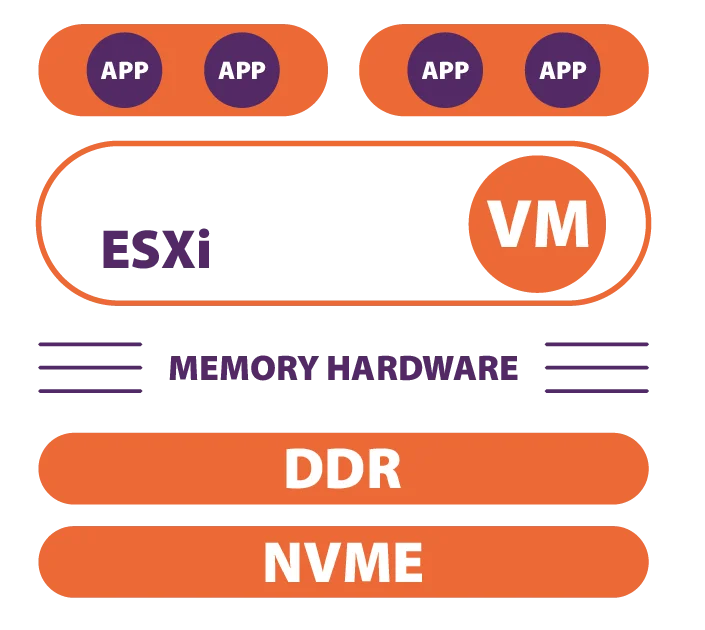
vSphere automatically determines which data should be stored in RAM and which can be offloaded to NVMe or other storage. This is based on monitoring and analysis algorithms, ensuring that high-performance tasks are handled by RAM while less critical tasks are delegated to the secondary tier.
The workload on each tier can fluctuate over time. For instance, if a virtual machine begins to consume significant resources, data with a lower priority may be migrated to the secondary tier, freeing up RAM for more demanding tasks.
Basic advantages of vSphere Memory Tiering:
- Cost reduction: Utilizing NVMe drives as an additional memory tier helps avoid the expense of additional RAM modules, which can be quite costly.
- Improved scalability: Memory Tiering enables you to scale up memory capacity, supporting an increased number of virtual machines or more resource-intensive workloads.
- Flexible memory management: The system automatically reallocates resources between tiers, ensuring optimal utilization of RAM for various workloads and applications.
- Stability and performance: By keeping critical data in primary memory, system performance is not compromised, while less critical tasks are handled by the secondary tier, reducing the load on RAM
vSphere Memory Tiering Suitable for a wide range of workloads, from cloud applications to memory-intensive databases. It is particularly beneficial for environments where memory resources are often constrained or where there is a need for rapid scaling during peak loads. This is also an ideal solution for organizations handling large datasets but seeking to avoid significant hardware costs.
Investing in vSphere Memory Tiering solutions will help organizations maximize the performance of their infrastructure, ensuring the stability and scalability necessary to thrive in today’s digital landscape.
Hostpark offers vSphere Memory Tiering as an additional service to optimize memory in cloud environments, enhancing your IT infrastructure and maximizing your environment’s performance.