
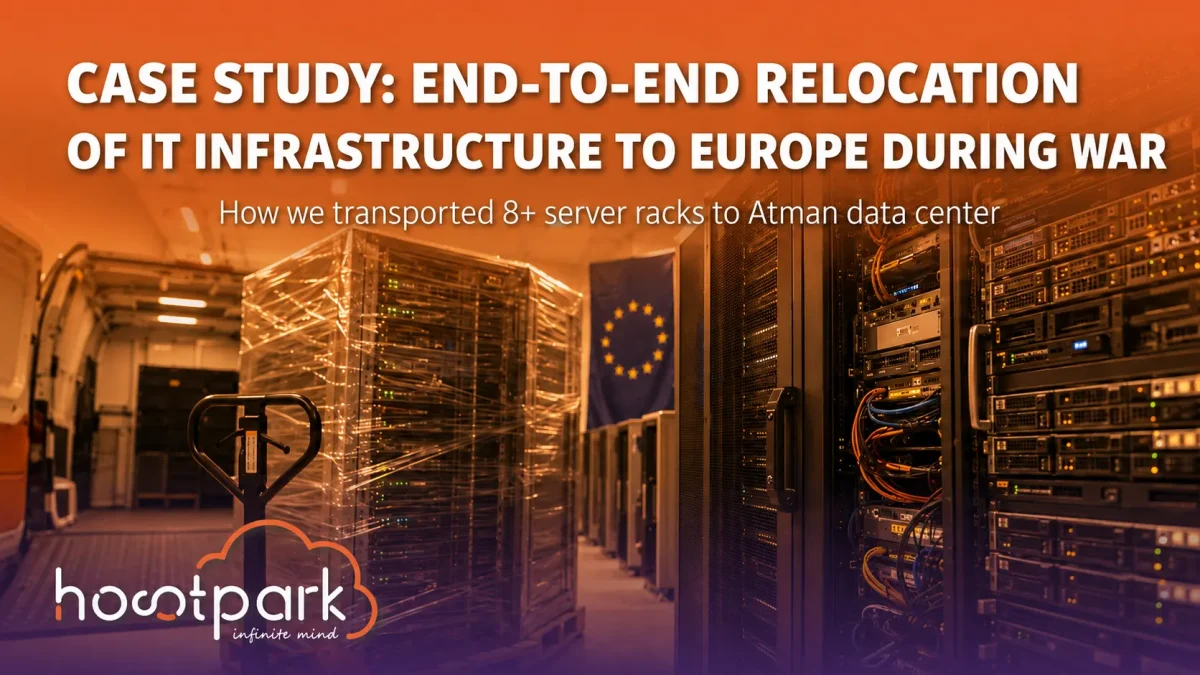
…How We Relocated 8+ Server Racks to the Atman Data Center
At the beginning of the full-scale invasion, Ukrainian businesses faced not only operational and staffing challenges. For companies whose critical services ran on their own physical equipment, one of the key risks became the physical location of their IT infrastructure.
One of Hostpark’s large clients approached us with a task whose scale required the simultaneous coordination of engineers, logistics specialists, lawyers, and representatives of a foreign data center: more than 8 server racks with operational IT infrastructure had to be relocated from Ukraine to Poland.
Hostpark had to organize the entire process – from planning the dismantling and international logistics to deploying and launching the equipment at the new site. As a result, the full project cycle, from the initial request to the launch of the infrastructure in Poland, took 2 months.
About the Client and the Main Challenge
The client operated a substantial amount of its own server and networking equipment. This was not a matter of moving several servers or migrating virtual machines between cloud platforms, but a physical relocation of more than 8 full server racks across a national border.
Projects of this kind require much broader planning than standard equipment transportation. Services must be shut down correctly, the existing connection scheme must be documented, equipment must be dismantled and labeled, prepared for transportation, cleared through customs, delivered to the data center, installed, connected, and the entire infrastructure must then be tested.
The client also required not standard equipment placement in a shared server space, but a separate physically isolated area. For this purpose, the Box Colocation format was selected within the infrastructure of the Polish data center operator Atman.
Hostpark is an official representative of Atman in Ukraine and provides Ukrainian companies with access to its infrastructure services, including solution design, migration, colocation, and technical support.
Why Box Colocation Was Chosen for the Project
Standard colocation involves installing the client’s own equipment in a professional data center. However, this project had higher requirements for the physical separation of the infrastructure.
The Box/Kiosk format at Atman allows server racks to be placed in an area separated from the shared space – behind a steel enclosure or inside a compact closed box. This format can include separate access control systems, video surveillance, and additional physical security measures.
This makes it possible to combine the benefits of a professional data center with an additional level of physical separation of the equipment, which is particularly relevant for companies with enhanced internal requirements for access to their IT infrastructure.
More information about available equipment placement options can be found on the Hostpark server colocation page.
What Tasks the Hostpark Team Had to Solve
Due to the scale of the project, simply finding transportation and reserving space in the data center was not enough. The relocation had to be designed as a single integrated process in which each subsequent stage depended on the correct execution of the previous one.
The team worked simultaneously across several areas:
- Technical design. The client’s existing architecture, equipment placement, power supply, connectivity, and requirements for the future deployment had to be analyzed.
- Logistics. The dismantling, packaging, and safe transportation of a large volume of server and networking equipment from Ukraine to Poland had to be organized.
- Customs support. The physical movement of commercial equipment across the border required the preparation of the relevant documents and coordination of customs procedures.
- Organizational coordination with Atman. Hostpark coordinated the site specifications, technical parameters of the future deployment, and the necessary organizational matters with the Polish side.
- Installation and launch. After delivery, the physical infrastructure and connectivity had to be restored, and the systems had to be tested in the new location.
A key requirement was to complete all of these tasks within controlled deadlines and carry out the switchover within a pre-agreed technical maintenance window.
Stages of the Relocation Project
1. Analysis of the Existing Infrastructure and Design
The work began not with dismantling the servers, but with inventory and design. The engineers needed to understand how the equipment interacted, which components were critical, in what sequence they could be shut down, and what the infrastructure should look like after installation in Poland.
At this stage, the team developed a plan for placing the equipment in a dedicated Box Colocation area, defined connectivity requirements, and prepared the sequence for the future migration.
For large infrastructures, this approach is critical. If physical relocation begins without a detailed connection diagram and a clear understanding of dependencies between systems, the time required to restore services after delivery can increase significantly.
2. Site and Organizational Coordination
At the same time, Hostpark coordinated the project with Atman. The parameters of the future deployment had to be agreed upon, the required infrastructure had to be prepared, and organizational and financial matters had to be synchronized with the project’s technical schedule.
For the client, this meant having a single point of coordination instead of having to work separately with carriers, the data center, and other participants in the process.
3. Preparing the Equipment for Relocation
The next stage was preparing the physical infrastructure for transportation. For a large server environment, proper labeling of equipment, cables, and components, as well as documenting the configuration and connection sequence, is especially important.
The equipment was dismantled according to the agreed plan, prepared for transportation, and the documentation required for further logistics was compiled.
4. International Logistics and Customs Support
One of the most complex stages of the project was the physical transportation of the server infrastructure across the Ukrainian-Polish border.
Hostpark organized the logistics process and provided support for customs procedures. For the client, this meant avoiding the need to divide responsibility among several separate contractors and made it possible to coordinate both the technical and logistics aspects within a single project.
5. Equipment Installation at Atman
After the equipment arrived in Poland, the reverse process began – installing servers and networking components in the prepared Box Colocation area, restoring connectivity, and connecting the infrastructure.
The Box/Kiosk format in Atman data centers is designed for projects with enhanced physical security requirements. It provides separation of server racks from the shared space and makes it possible to organize dedicated access control.
6. Testing and Service Launch
The final stage involved checking physical connections, network availability, and system operation after the relocation.
The switchover was completed within the agreed technical maintenance window. After the checks were completed, the client’s infrastructure continued operating at the Atman site in Poland.
Result: More Than 8 Racks Relocated to Poland in 2 Months
Two months passed from the client’s initial request to the completion of the equipment launch at the new site. During this time, the team designed the new deployment, coordinated with Atman, prepared international logistics, supported the equipment relocation, and ensured its installation in Poland.
As a result, the client received:
- physical IT infrastructure relocated outside Ukraine – more than 8 server racks were moved to Poland;
- a dedicated environment for equipment placement in the Box Colocation format;
- a significant reduction in geographic and infrastructure risks associated with hosting critical equipment in Ukraine during the war;
- a controlled transition process with a predefined technical maintenance window;
- a single team responsible for project delivery – from technical planning and logistics to installation at the new site.
At the same time, the equipment remained the client’s property. Instead of moving to a different IT infrastructure model, the company was able to preserve its existing hardware environment while physically relocating it to a professional data center in the EU.
What This Case Shows Businesses with Their Own IT Infrastructure
Migration to Europe does not necessarily mean completely abandoning your own equipment and moving to a public cloud. If a business has already invested in servers, data storage systems, and networking equipment, one possible scenario is the physical relocation of the infrastructure to a European data center.
This approach may be particularly relevant for companies that require control over their own equipment, dedicated physical placement, or preservation of an existing architecture without completely rebuilding their IT environment.
Comment from the Hostpark team: “Relocating several servers and moving more than eight full server racks are projects of completely different levels of complexity. In the second case, the key factor is not the transportation itself, but the precise planning of the entire chain: dismantling, labeling, documentation, logistics, installation, connectivity, and launch. Hostpark’s role in such a project is to bring these processes together and provide the client with a single point of coordination.”
Server Equipment Relocation to Poland with Hostpark
Hostpark provides a server equipment relocation service to Poland and supports projects at different stages – from preparing the technical plan to deploying equipment in a data center.
The configuration, timeline, logistics scheme, and colocation format for each project are determined individually depending on the amount of equipment, its characteristics, power requirements, connectivity, physical security requirements, and the permissible technical maintenance window.
If a company needs to relocate its own IT infrastructure to Europe, Hostpark can prepare a solution tailored to the technical and organizational requirements of the specific project.