


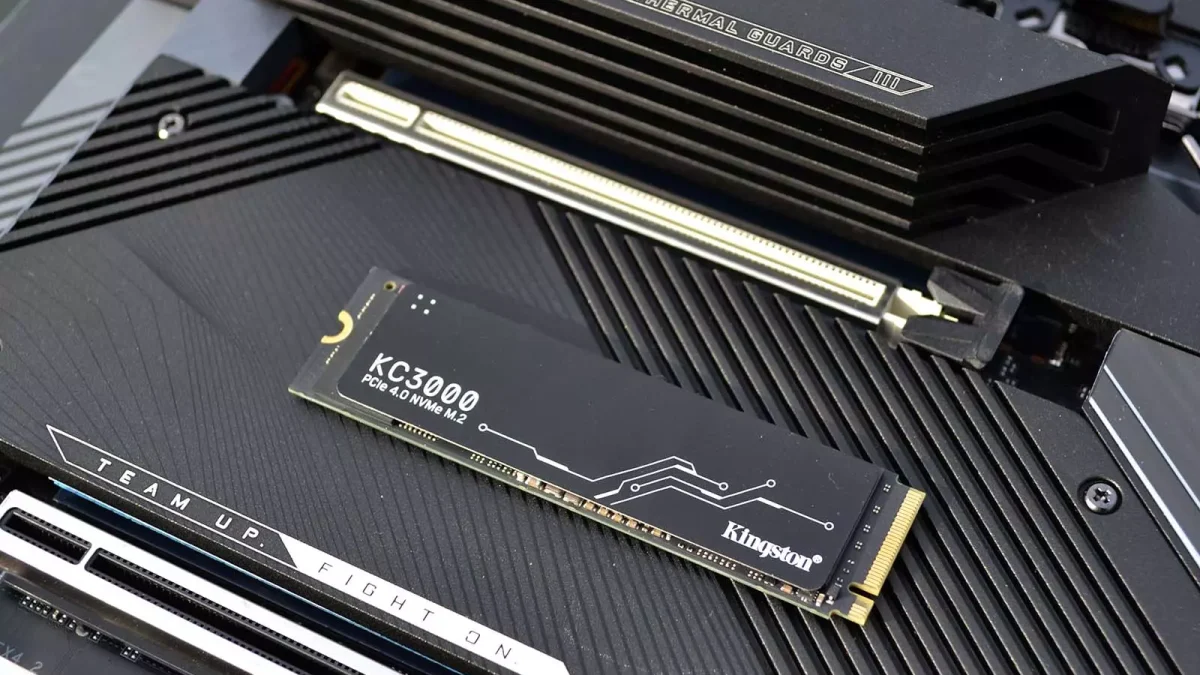
NVMe drives have become one of the main standards of modern server infrastructure, hosting, VPS environments, and high-load web projects. Just a few years ago, such storage devices were considered an expensive solution for powerful workstations, data centers, and specialized servers, but today NVMe is increasingly used even in mass-market hosting plans. The reason is simple: websites, CMS platforms, databases, CRM systems, and online stores require fast file access, stable performance under load, and minimal latency during request processing.
At the same time, it is important to understand that NVMe does not always become cheaper linearly or during every market cycle. SSD prices depend on NAND memory production, demand from data centers, manufacturing cycles, and competition between vendors. In the long term, the technology has become more affordable than it was at launch, but in the short term the market may still experience price increases for certain models. Despite this, NVMe remains the standard because its advantage lies not only in pricing, but also in performance, scalability, and server stability. The hosting SSD format is suitable for websites that require stable loading speed, fast file access, and reliable operation under daily workloads.
What Are NVMe Drives in Simple Terms?
NVMe is a modern protocol designed specifically for high-speed solid-state storage. Simply put, NVMe allows an SSD to communicate with the processor through the fast PCIe bus instead of the older SATA interface. That is why NVMe drives can operate significantly faster than traditional SATA SSDs, especially when a server handles many read and write operations simultaneously.
NVMe is often referred to as a separate type of SSD, although technically it is a storage access protocol. The phrase “NVMe drive” became common because most of these devices use M.2, U.2, or server-oriented form factors and are immediately associated with high performance. For a website owner, the technical terminology matters less than the practical result: pages load faster, databases respond quicker, CMS platforms operate more smoothly, and VPS servers handle peak traffic better. SSD hosting helps websites perform faster thanks to rapid file access, stable request processing, and improved performance under load.
In short, SSD is a solid-state storage device without moving mechanical parts, while NVMe is one of the fastest methods for connecting such storage to a system. Instead of mechanical components, spinning platters, and magnetic disks like HDDs use, SSDs rely on memory chips. The absence of mechanical parts gives SSDs low latency, while NVMe additionally removes many of the limitations associated with SATA.
How Is NVMe Different from Traditional SSDs?
When people mention “regular SSDs,” they usually mean SATA SSDs. These drives are already much faster than HDDs, but they still operate through the SATA interface, which was originally designed for hard drives. At the time, SATA SSDs represented a major step forward: they accelerated operating system boot times, software performance, file access, and basic server operations. However, for modern workloads where parallel processing of many requests is critical, SATA has natural limitations.
NVMe works through PCIe, which provides a much wider data transfer channel and a more efficient command queue system. This is especially important for servers where the web server, database, cache, mail services, control panel, backup system, and background tasks all operate simultaneously. In such environments, not only maximum throughput matters, but also how many small operations the drive can process without delays.
For a simple website with only a few pages, the difference between SATA SSD and NVMe may not always be noticeable at first. But when traffic grows, product catalogs expand, user activity increases, database requests become more frequent, and background tasks multiply, NVMe provides a more visible advantage. That is why providers developing SSD hosting infrastructure increasingly move to NVMe or use it in high-performance hosting plans.
What Is the Difference Between HDD, SATA SSD, and NVMe?
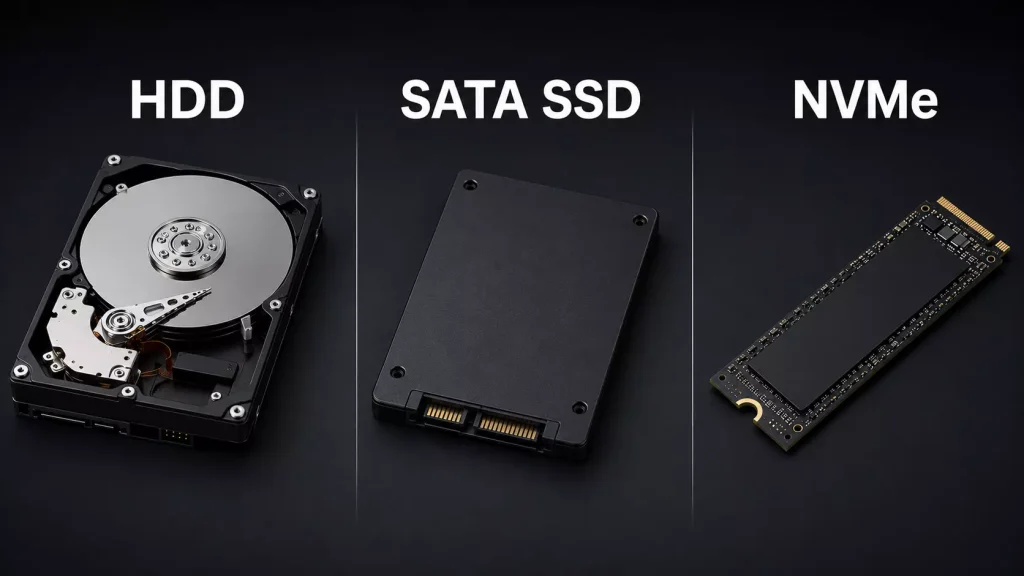
HDD, SATA SSD, and NVMe differ not only in speed, but also in how they work internally. HDD is a mechanical hard drive with spinning platters and a read/write head. SATA SSD is a solid-state drive without moving parts, but connected through the SATA interface. NVMe is an SSD that uses PCIe and a modern protocol for high-speed data access.
For websites and servers, this difference appears in three main areas: read and write speed, data access latency, and stability under simultaneous workloads. These parameters determine how quickly a CMS opens pages, how fast a database finds records, and how rapidly a server responds to user requests.
Read and Write Speed
An HDD usually provides sequential read speeds of around 80-250 MB/s depending on the model, rotational speed, drive condition, and workload type. SATA SSDs generally approach the limit of the SATA interface and often deliver around 500-560 MB/s in sequential read operations. NVMe drives are much faster: PCIe 3.0 models often reach 3000-3500 MB/s, PCIe 4.0 drives achieve 5000-7400 MB/s, while PCIe 5.0 consumer drives can exceed 10000 MB/s in sequential reads.
For websites, not only large file transfer speed matters. If a page contains many media files, cached elements, templates, and database calls, the drive constantly performs many small operations. That is why NVMe is especially useful for WordPress, WooCommerce, Magento, OpenCart, Laravel projects, CRM systems, and platforms that frequently read and write small blocks of data.
Data Access Latency
Latency is the delay between a request for data and the moment the system receives a response. HDDs have higher latency because of their mechanical nature: the read/write head physically moves to the required area of the disk. SSDs and NVMe drives do not use mechanics, so data access happens much faster.
Low latency is especially important for servers, CMS platforms, and databases. When a user opens a page, the server may perform dozens or hundreds of small operations: reading configuration files, retrieving database records, checking cache, loading templates, and generating responses. If each operation has lower latency, the overall server response time decreases. That is why NVMe often produces noticeable improvements not only in benchmarks but also in real-world website performance.
Performance Under Heavy Load
Under heavy workloads, the difference between storage types becomes even more obvious. HDDs can handle simple storage tasks, but they quickly hit mechanical limitations when many requests occur simultaneously. SATA SSDs perform much better, but they are still restricted by SATA bandwidth and less efficient command queue processing. NVMe is better suited for parallel operations, which allows it to remain more stable when websites, databases, caching systems, logging, backups, and user interactions all operate at the same time.
This does not mean that NVMe automatically solves all performance issues. If a website is poorly optimized, uses heavy plugins, inefficient SQL queries, or lacks enough RAM, a fast drive cannot replace proper optimization. However, under equal conditions, NVMe creates a much stronger foundation for fast and stable performance.
NVMe vs SATA SSD Performance Comparison
The comparison below is approximate. Real-world performance depends on the specific drive model, controller, NAND memory type, firmware, cooling, RAID configuration, file system, virtualization settings, and hosting provider limitations.
| Storage Type | Sequential Read | Approximate IOPS | Typical Latency | Server Use Cases |
| HDD | 80-250 MB/s | Dozens or hundreds of operations | Approximately 5-15 ms | Archives, backups, low-cost bulk storage |
| SATA SSD | 500-560 MB/s | Tens of thousands of operations | Tenths or hundredths of a millisecond | Websites, control panels, medium projects, entry-level VPS |
| NVMe PCIe 3.0/4.0/5.0 | 3000 MB/s to 10000+ MB/s | Hundreds of thousands or over a million operations in high-end models | Tens of microseconds in optimal conditions | VPS, databases, e-commerce, CRM, high-load systems |
The table highlights the main point: SATA SSD is already much faster than HDD, but NVMe opens an entirely different level of performance. For hosting, this means faster access to website files, quicker database operations, improved server response during traffic spikes, and greater scalability for future growth.
Why Has NVMe Become the Standard for Servers and Hosting?
NVMe became the standard not because of marketing, but because workloads have changed. Modern websites are no longer just static HTML pages. They work with CMS platforms, databases, caching systems, APIs, personalized content, payment systems, user accounts, and analytics tools. Every such component creates read and write operations, which increases pressure on the storage subsystem.
That is why data centers and hosting providers are moving to NVMe: it allows them to process more operations without severe performance degradation. For clients, this translates into practical benefits rather than abstract technical numbers: websites respond faster, admin panels work more smoothly, product imports become more stable, databases freeze less frequently under load, and VPS servers gain a larger performance reserve.
Main reasons why NVMe became standard in server infrastructure:
- Higher bandwidth compared to SATA SSD.
- Lower data access latency.
- Better parallel processing for large numbers of requests.
- Greater efficiency for databases, caching, and virtualization.
- Improved performance reserves for VPS, e-commerce, CRM, and enterprise systems.
- Gradual long-term reduction in technology costs.
- Easier scalability for data center infrastructure.
As a result, NVMe gradually stopped being a premium-only option and became a baseline requirement for modern fast hosting. If a project has already outgrown shared hosting, the next logical step may be SSD VDS in Poland, where not only CPU and RAM matter, but also storage subsystem performance.
How Does NVMe Affect Website and VPS Speed?

NVMe affects website speed not as a “magic button,” but by reducing the time required to access files and data. When a user opens a page, the server processes PHP code, queries the database, checks cache, reads theme files, plugins, images, and configuration files. If the drive responds quickly, the server spends less time waiting for input/output operations.
This is especially important for VPS environments because a virtual server often performs several roles simultaneously: web server, database, mail service, cache, control panel, log storage, and backup environment. If the storage is slow, even a powerful processor may simply wait for disk operations to complete. NVMe reduces such delays and allows the system to utilize CPU and RAM more efficiently.
For CMS platforms like WordPress or OpenCart, NVMe can improve admin panel responsiveness, catalog searches, product updates, cache generation, CRON tasks, and media library operations. For online stores, this affects filter speed, shopping cart responsiveness, checkout processing, product imports, and synchronization with external services.
At the same time, fast storage does not eliminate other performance factors. Website speed also depends on code quality, caching, image optimization, PHP version, web server configuration, RAM capacity, processor performance, network quality, and the distance to the data center. Therefore, NVMe should be considered an important part of a complete infrastructure rather than the only selection criterion. For a broader understanding of hosting options, it is useful to know how to choose hosting for your website depending on project requirements, budget, and workload level.
Benefits for Databases and High-Load Projects
Databases are one of the main reasons why NVMe has become so important for servers. MySQL, MariaDB, PostgreSQL, and other DBMS solutions constantly perform small read and write operations. For databases, not only high sequential throughput matters, but also random access speed, low latency, and stable IOPS.
An online store with thousands of products, filters, inventory tracking, order history, and customer accounts creates a far more complex workload than a simple business website. Every user action may trigger several database requests: product search, price verification, discount calculation, cart updates, stock validation, and order creation. When many users perform these actions simultaneously, the storage subsystem becomes one of the key stability factors.
NVMe is also important for CRM systems, ERP platforms, SaaS services, analytics dashboards, booking systems, educational platforms, and enterprise portals. In such projects, data is not simply stored – it is constantly modified, filtered, sorted, and written. The lower the disk latency, the faster the system can respond to both user requests and internal operations.
Caching should also be mentioned separately. Redis, Memcached, OPcache, and page caching reduce the number of disk operations, but they do not eliminate them completely. During cache clearing, content updates, page generation, or large catalog operations, the storage subsystem again becomes important. NVMe helps handle such moments more smoothly, especially when websites experience regular traffic spikes.
Why Are NVMe Drives Becoming Cheaper?
NVMe drives have become more affordable in the long run because of technological development and mass production. At the beginning, any new technology is expensive: manufacturers are still refining production, controllers are released in limited quantities, server hardware adapts to new standards, and demand comes mainly from professional users. As technology becomes mainstream, the price per gigabyte gradually decreases.
Several factors contributed to lower NVMe costs. NAND memory manufacturers moved to denser technologies, increased the number of layers in 3D NAND, optimized controllers, and expanded product lines. Competition between brands also made NVMe more accessible for the mass market. While high-speed NVMe was once considered an expensive solution for enthusiasts and servers, today such drives are widely used in laptops, workstations, VPS infrastructure, private clouds, and data centers.
However, the situation should not be oversimplified. In the short term, SSD prices may rise because of NAND shortages, demand from AI infrastructure, corporate закупки, and manufacturing changes. Therefore, it is more accurate to say that NVMe has become more affordable as a technology compared to its launch period, while current prices still depend on market cycles. For hosting providers, what matters is not only the cost of a single drive, but also the level of performance, stability, and storage density it delivers to the server.
What Types of NVMe Drives Exist?
NVMe drives differ by PCIe generation, form factor, NAND memory type, controller, write endurance, power-loss protection, and intended use. A home PC and a data center may both use NVMe drives, yet the reliability characteristics can differ dramatically.
When evaluating NVMe, it is important to look beyond maximum advertised speeds. For servers, factors such as stability under sustained workloads, write endurance, thermal behavior, monitoring support, predictable RAID behavior, and platform compatibility are critical.
The main NVMe categories can be divided as follows:
- PCIe 3.0 NVMe – still relevant drives with a strong balance between price, speed, and compatibility for many server workloads.
- PCIe 4.0 NVMe – more powerful solutions for VPS, databases, online stores, high-load websites, and modern servers.
- PCIe 5.0 NVMe – extremely fast drives for workloads requiring maximum bandwidth, though they demand more advanced cooling.
- Consumer NVMe – drives for personal computers and laptops that are not always designed for constant server workloads.
- Enterprise NVMe – drives with higher endurance, improved stability, stronger data protection, and predictable operation in data centers.
Website or VPS users do not always see the exact drive model, but they can evaluate the provider’s infrastructure approach. If the service is aimed at stable business project hosting, then not only the words “NVMe” or “SSD” matter, but also redundancy, monitoring, networking, technical support, and transparent data center architecture.
NVMe Drawbacks Worth Knowing About
NVMe has clear advantages, but it is not a perfect solution without trade-offs. The first important factor is heat generation. Fast PCIe 4.0 and PCIe 5.0 drives can become very hot under sustained workloads. If cooling is insufficient, the drive may reduce performance to avoid overheating. In servers, this issue is addressed through proper airflow, heatsinks, optimized drive placement, and temperature monitoring.
The second factor is compatibility. Not every server platform supports the required number of NVMe drives, the appropriate PCIe generation, or the needed form factor. On older hardware, NVMe may not operate at full speed or may require additional adapters. For data centers, this is an infrastructure planning issue, while for VPS users it becomes a matter of choosing a provider that has properly configured the hardware layer.
The third factor is enterprise drive pricing. Consumer NVMe drives may be affordable, but enterprise-grade drives with high write endurance, power-loss protection, and stable operation under load are significantly more expensive. That is why hosting quality should not be judged solely by the phrase “NVMe storage.” It is equally important to know which drives are used, how redundancy is implemented, how equipment health is monitored, and whether the provider has mature operational practices.
Why Are Modern Hosting Providers Switching to NVMe?
Modern hosting providers are moving to NVMe because client projects are becoming more demanding. Even a small business website today may include a CMS, blog, forms, analytics, CRM integrations, payment modules, user accounts, and regular backups. All of this creates server load, while fast storage helps maintain stability.
SSD hosting makes it possible to improve response times, reduce disk queue risks, accelerate backup operations, speed up migrations, and improve overall service quality. For customers, this means faster website performance, more stable admin panels, fewer issues during traffic spikes, and stronger technical foundations for SEO.
Search engines consider user experience, loading speed, and website availability stability. NVMe alone does not guarantee high rankings, but it helps create the technical foundation for a fast website. If a site is slow because of poor code or heavy media files, a fast drive alone will not solve the issue. However, if the rest of the infrastructure is optimized, high-speed storage becomes an important part of the final result.
Professional environments also require infrastructure monitoring. Even a fast server needs regular monitoring of uptime, workloads, response times, and behavior during traffic peaks. That is why business projects should combine fast storage with proper website and server monitoring, backups, and clear incident response procedures.
NVMe is also valuable during migrations. When a project owner decides to move a website to another hosting provider, storage performance affects archive creation, file extraction, database imports, and initial testing. For large websites, this can reduce migration downtime and minimize the risk of prolonged outages.
For projects requiring not only a virtual machine but also full control over physical resources, dedicated servers in Poland remain relevant. Such environments allow more precise selection of processors, RAM, storage types, RAID configurations, and network parameters for specific workloads. Companies evaluating infrastructure more broadly may also benefit from understanding how a data center works and why storage is only one component of a reliable server ecosystem.
Conclusion
NVMe is not simply a “faster SSD,” but a modern standard for accessing solid-state storage through PCIe, better suited for servers, VPS environments, databases, and high-load websites. Its key advantage lies in high bandwidth, low latency, and the ability to process many parallel operations consistently.
Compared to HDDs, NVMe delivers an entirely different level of speed. Compared to SATA SSDs, it scales much better under load and offers significantly greater potential for modern web projects. That is why NVMe has become the standard for hosting, VPS infrastructure, data centers, online stores, CRM systems, and enterprise platforms.
Although SSD prices may fluctuate because of the NAND memory market, NVMe remains a strategically important technology. In the long term, it has become more affordable, more widespread, and more practical for infrastructure solutions. For website owners, this means one simple thing: fast storage does not replace optimization, but it creates a reliable foundation for fast, stable, and scalable project performance.
If a website grows, the database becomes heavier, the admin panel slows down, or the VPS can no longer handle traffic spikes, it is worth evaluating not only CPU and RAM, but also the storage subsystem itself. In many cases, moving to NVMe-based infrastructure can become one of the most noticeable technical upgrades for improving website performance and preparing the project for future growth.